


Page 182 - Modern physical chemistry
P. 182
174                       Equilibria in Condensed Phases

             we have
                                                                                     [8.31 J


             But note that writing (8.30) in the form

                                      H 20 (1) (  ) H+ (aq) + OH- (aq)               [8.32J

             yields
                                           _  aH+a OH - _
                                         K -         - aH+a OH -'                    [8.33J
                                              aH20
             essentially the same final form. For other reactions, a similar remark applies. So in equi-
             librium studies, we will symbolize the hydrogen ion in water merely as W  (aq).
                When a crystal is effectively pure and under 1 bar pressure, it is in its standard state
             and its actiVity may be taken as 1. For the reaction
                                                                                     [8.34J

             we have

                                                                                     [8.35J


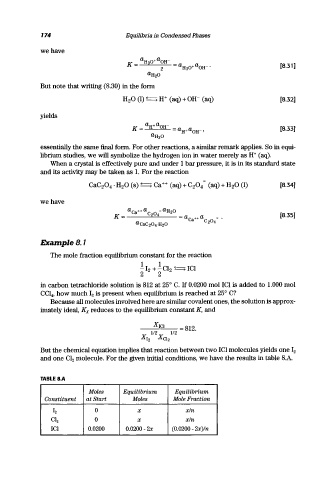
             ExampleB.l
                The mole fraction equilibrium constant for the reaction
                                           1     1
                                           - 12 + -C1 2  (   ) ICI
                                           2     2
             in carbon tetrachloride solution is 812 at 25° C. If 0.0200 mol ICI is added to 1.000 mol
             CCI 4 ,  how much 12  is present when equilibrium is reached at 25° C?
                Because all molecules involved here are similar covalent ones, the solution is approx-
             imately ideal, Kx reduces to the equilibrium constant K, and


                                           __ X-,-IC=I __ = 812.
                                              112   112
                                           X I2  X CI2
             But the chemical equation implies that reaction between two ICI molecules yields one 12
             and one Cl 2  molecule. For the given initial conditions, we have the results in table 8.A.


             TABLE S.A

                            Moles     Equilibrium     Equilibrium
              Constituent   at Start     Moles       Mole Fraction

                 12           0           x              x/n
                CI 2          0           x              x/n
                ICI         0.0200     0.0200-2x     (0.0200 - 2x)/n

