


Page 186 - Modern physical chemistry
P. 186
178                      Equilibria in Condensed Phases

             Throughout such a region,  electrical neutrality tends to exist. At a boundaIy, however,  a
             charged sheath may fonn. Also, about iridividual ions, microscopic charged atmospheres fonn.
                In working a problem, the expressions obtained from the chemical equations are sub-
             stituted into the equilibrium constant formulas. For systems involving several ions, the
             electrical neutrality condition may also be invoked.
                When the concentrations of all the ions are low, one may consider the activity coef-
             ficients to equal  1.  A theory for ionic activity coefficients will be developed later and
             approximate results for common ions tabulated.
                However the activity coefficients are chosen for a particular problem, a person faces
             a mixed set of nonlinear and linear equations. These may be combined to give a single
             equation
                                                f(x)=O,                              [8.36]


             in which x represents the equilibrium extent of reaction measured in some manner while
             f(x) is a polynomial. Equation (8.36) is then solved. But besides the desired positive root,
             this may have complex roots, negative roots,  and positive roots that impose negative
             values on one or more concentrations.
                Alternatively, a person may work with the simultaneous equations directly, rearrang-
             ing them so that approximate concentrations on the right yield better values on the left.
             Letting the concentrations be w, x, y, and z, one constructs the set

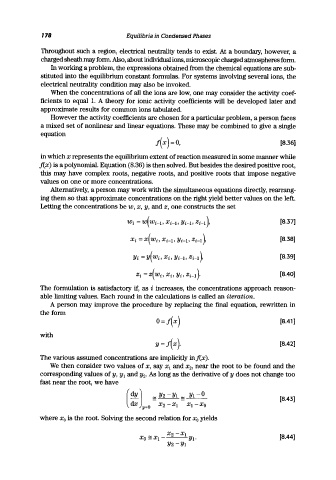
                                       Wi = W( Wi-I, Xi-I, Yi-I, Zi-I ),             [8.37]


                                        Xi  =X(Wi' Xi-I, Yi-I, Zi-I),                [8.38]

                                                                                     [8.39]

                                                                                     [8.40]
             The formulation is satisfactory if,  as i  increases, the concentrations approach reason-
             able limiting values. Each round in the calculations is called an iteration.
                A person may improve the procedure by replacing the final equation,  rewritten in
             the form
                                                O=f(x)                               [8.41 ]

             with
                                                Y=f{X).                              [8.42]

             The various assumed concentrations are implicitly inf(x).
                We then consider two values of x, say Xl  and X 2 , near the root to be found and the
             corresponding values of y, Yl and Y2.  As long as the derivative of Y does not change too
             fast near the root, we have

                                       (  :  )   ==  Y2  - YI  ==  YI  - 0           [8.43]
                                            y=o   X2 -Xl   Xl -Xo
             where Xo is the root. Solving the second relation for Xo  yields

                                                                                     [8.44]

