


Page 190 - Modern physical chemistry
P. 190
182                       Equilibria in Condensed Phases

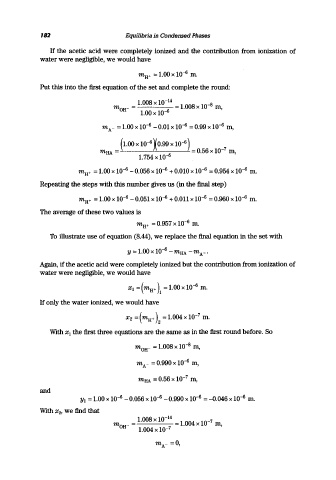
                If the acetic acid were completely ionized and the contribution from ionization of
             water were negligible, we would have

                                           m H +  = 1.00 x 10⁻⁶  m.

             Put this into the first equation of the set and complete the round:

                                         = 1.008 x 10- 14   = 1 008  10-8
                                   m OH -               •   x     m,
                                           1.00 x 10⁻⁶
                                m A - = 1.00 x 10⁻⁶ - 0.01 x 10-6 = 0.99 x 10- 6  m,

                                     (1.00 x 10-6 X 0.99 x 10-6 )   -7
                               mBA =                       =0.56xl0  m,
                                           1.754 x 10--5
                         mw = 1.00 x 10- 6  - 0.056 x 10⁻⁶ + 0.010 x 10-6 = 0.954 x 10⁻⁶  m.

             Repeating the steps with this number gives us (in the final step)

                         m +  = 1.00 x 10⁻⁶ - 0.051 x 10⁻⁶ + 0.011 x 10-6 = 0.960 x 10⁻⁶  m.
                           H
             The average of these two values is
                                          mw = 0.957 x 10⁻⁶  m.

                To illustrate use of equation (8.44), we replace the final equation in the set with
                                       Y = 1.00 x 10⁻⁶ -mBA -m A -.

             Again, if the acetic acid were completely ionized but the contribution from ionization of
             water were negligible, we would have

                                        Xl = (mw )1  = 1.00 x 10⁻⁶  m.

             If only the water ionized, we would have
                                                            7
                                       X2 = (mH+ )2 = 1.004 x 10- m.

                With Xl the first three equations are the same as in the first round before. So
                                          m OH - = 1.008 x 10⁻⁸  m,

                                          m - = 0.990 x 10⁻⁶ m,
                                            A
                                           mBA = 0.56 x 10- 7  m,
             and
                         Y1  = 1.00 x 10⁻⁶ - 0.056 x 10⁻⁶ - 0.990 x 10-6 = -0.046 x 10⁻⁶  m.
             With X2, we find that
                                   m  _ = 1.008 X 10- 14   = 1.004 x 10⁻⁷  m,
                                     OH    1.004 x 10⁻⁷

