


Page 194 - Modern physical chemistry
P. 194
186                       Equilibria in Condensed Phases

                In principle, one could map out an electric field using a small test charge. The force
             per unit charge acting on the test charge, at rest at a certain point, is the electric inten-
             sity E at that point.
                Coulomb's law, in its simplest form, states that the electric intensity produced by a
             point charge of magnitude q is

                                              E=-q-rl>                               [8.51 ]
                                                 4ner 2
             where vector r is drawn from the source charge to the point at which the test charge is
             placed, r l  is the unit vector giving the direction of r (r = rr l ), and e is the dielectric con-
             stant of the inteIVening medium.
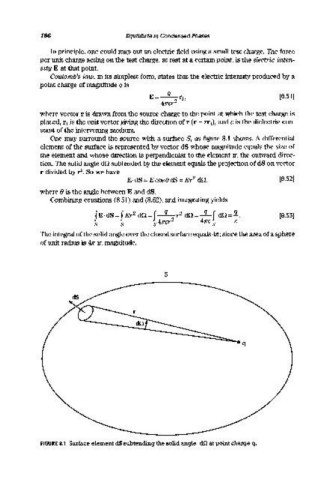
                One may surround the source with a surface S,  as figure  8.1  shows. A differential
             element of the surface is represented by vector dS whose magnitude equals the size of
             the element and whose direction is perpendicular to the element in the outward direc-
             tion. The solid angle dO. subtended by the element equals the projection of dS on vector
             r divided by r. So we have
                                       E·dS = Ecos(}dS = Er2 dO.,                    [8.52]
             where () is the angle between E and dS.
                Combining equations (8.51) and (8.52), and integrating yields

                             fE.dS= f Er2 <in = f~r2 dn=~f <in=.[.                   [8.53]
                             s       s         s 4ner        4ne s     e
             The integral of the solid angle over the closed surface equals 4Jr; since the area of a sphere
             of unit radius is 4Jr in magnitude.


                                                  s


             FIGURE 8.1  Surface element dS subtending the solid angle  d.{l at point charge q.

