


Page 198 - Modern physical chemistry
P. 198
190                       Equilibria in Condensed Phases

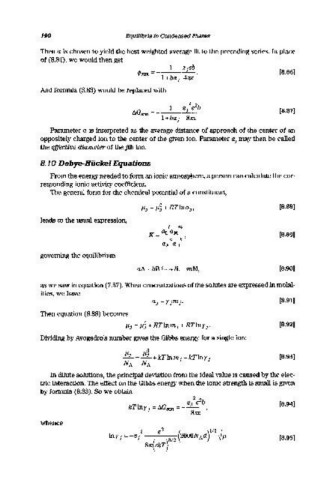
             Then a is chosen to yield the best weighted average fit to the preceding series. In place
             of (8.81), we would then get
                                          ifJatm  = __ 1_ Z jeb .                    [8.86J
                                                  l+baj  4m,
             And formula (8.83) would be replaced with

                                                          2  2
                                         ~Gatm = ___ l_Zj e b.                       [8.87J
                                                  l+baj  8m,

                Parameter a is interpreted as the average distance of approach of the center of an
             oppositely charged ion to the center of the given ion. Parameter a j  may then be called
             the effective diameter of the jth ion.

             8.10 Debye-Hiickel Equations
                From the energy needed to form an ionic atmosphere, a person can calculate the cor-
             responding ionic activity coefficient.
                The general form for the chemical potential of a constituent,

                                                                                     [8.88J
             leads to the usual expression,

                                                                                     [8.89J


             governing the equilibrium

                                          aA+bB (  ) lL+mM,                          [8.90J

             as we saw in equation (7.57). When concentrations of the solutes are expressed in molal-
             ities, we have
                                                                                     [8.91 J

             Then equation (8.88) becomes

                                       Pj = pJ +RTlnmj +RTlny j.                     [8.92J
             Dividing by Avogadro's number gives the Gibbs energy for a single ion:
                                             o
                                       Pj  =  Pj  +kTlnmj +kTlny j.                  [8.93J
                                      NA    NA
                In dilute solutions, the principal deviation from the ideal value is caused by the elec-
             tric interaction. The effect on the Gibbs energy when the ionic strength is small is given
             by formula (8.83). So we obtain
                                                         z.2e 2 b                    [   J
                                        kTlny j  = ~Gatm = __ J __                    8.94
                                                               ,
                                                          8m,
             whence

                                                                                     [8.95J

