


Page 202 - Modern physical chemistry
P. 202
194                      Equilibria in Condensed Phases

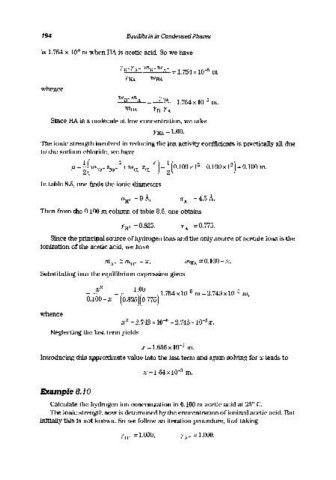
             is 1.754 X  10-0 m when HA is acetic acid. So we have

                                     YH+Y A- mH+mA- = 1.754 x 10⁻⁵  m
                                       YHA    mHA
             whence
                                                 YHA   1.754 x 10- 5  m.
                                      mHA      YH+Y A-
                Since HA is a molecule at low concentration, we take
                                               YHA  = 1.00.
             The ionic strength involved in reducing the ion activity coefficients is practically all due
             to the sodium chloride; we have

                      )1 = ~( mNa+z Na + 2 +mC1-z C1 -2)= ~(0.100 x 12 +0.100 x 12)= 0.100 m.

             In table 8.5, one finds the ionic diameters


             Then from the 0.100 m column of table 8.6, one obtains

                                     Y H + = 0.825,
                Since the principal source of hydrogen ions and the only source of acetate ions is the
             ionization of the acetic acid, we have
                                                        mHA  ~0.100-x.

             Substituting into the equilibrium expression gives

                              x'  ~(     I;  )1.754xIO-<im~2.743xW-5m,
                           0.100-x    0.825  0.775

             whence
                                      x 2  = 2.743 x 10⁻⁶ -2.743 x 1O- 5 x.
                Neglecting the last term yields
                                            x = 1.656 x 10- 3  m.
             Introducing this approximate value into the last term and again solving for x leads to

                                            x = 1.64 x 10⁻³ m.


             Example 8.10
                Calculate the hydrogen ion concentration in 0.100 m acetic acid at 25° C.
                The ionic strength now is determined by the concentration of ionized acetic acid. But
             initially this is not known. So we follow an iteration procedure, first taking

                                     Yw =1.000,        Y A- =1.000.

