


Page 206 - Modern physical chemistry
P. 206
198                      Equilibria in Condensed Phases

             gives us
                                                     VI
                                                                v2
                                      RTlna=RTlnal  +RTlna2  ,                      [8.115]
             whence
                                                                                    [8.116]
             The activity of a completely ionized electrolyte equals the activity of the cation raised to
             a power equal to the number of cations times the activity of the anion raised to a power
             equal to the number of anions in the formula of the electrolyte.

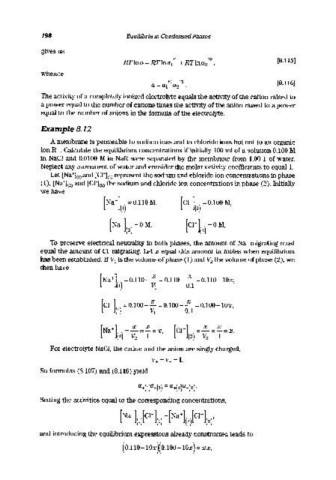
             Example 8.12

                A membrane is permeable to sodium ions and to chloride ions but not to an organic
             ion R- . Calculate the equilibrium concentrations if initially 100 rnl of a solution 0.100 M
             in NaCI  and 0.0100 M in NaR were separated by the membrane from  1.00  1 of water.
             Neglect any movement of water and consider the molar activity coefficients to equal 1.
                Let [Na+h and [Cl-lel) represent the sodium and chloride ion concentrations in phase
             (1),  [Na+l(2) and [Cq(2) the sodium and chloride ion concentrations in phase (2). Initially
             we have

                                [Na+ ](1) = 0.110 M,   [CI-](1)  = 0.100 M,


                                  [Na+ ](2) = 0 M,       [CI-](2) = 0 M,

                To preserve electrical neutrality in both phases, the amount of Na+  migrating must
             equal the amount of Cl" migrating. Let x  equal this amount in moles when equilibrium
             has been established. If VI is the volume of phase (l) and V 2 the volume of phase (2), we
             then have
                               [Na+]() =0.110-"£= 0.110-~ =0.110-10x,
                                     1         ~         Q1


                                [ CI-]( ) = 0.100-"£ = 0.100-~ = 0.100-10x,
                                    1         ~          Q1

                               [Na+l2)=~ =~=x,  [CI-](2)=~ =~=x.


                For electrolyte NaCI, the cation and the anion are singly charged,
                                               v+=v_=l.
             So formulas (8.107) and (8.116) yield


             Setting the activities equal to the corresponding concentrations,


             and introducing the equilibrium expressions already constructed leads to
                                      (0.110 -lOx)( 0.100 -lOx) = xx,

