


Page 205 - Modern physical chemistry
P. 205
B.11 Equilibria Among Phases Revisited             197

             and
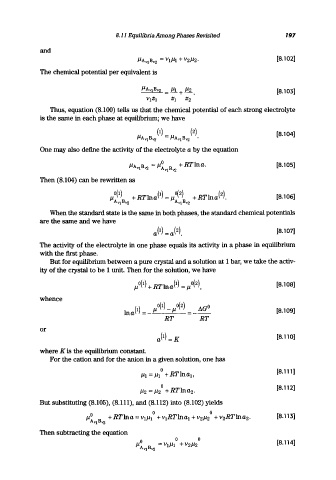
                                          J1.Avl BV2  = v1J1.1 + v2J1.2·            [8.102J

             The chemical potential per equivalent is


                                                                                    [8.103J

                Thus, equation (8.100) tells us that the chemical potential of each strong electrolyte
             is the same in each phase at equilibrium; we have

                                                (1) _     (2)                       [8.104J
                                          J1.AVl B V2   - J1.AVl B V2   •
             One may also define the activity of the electrolyte a by the equation

                                        J1.AVl BV2  = J1.1 Vl BV2  + RTlna.         [8.105J

             Then (8.104) can be rewritten as

                                  /(1)   +RTlna(1)=J1.*)   +RTlna(2).               [8.106J
                                   AVl BV2           AVl BV2
                When the standard state is the same in both phases, the standard chemical potentials
             are the same and we have
                                                                                    [8.107J
             The activity of the electrolyte in one phase equals its activity in a phase in equilibrium
             with the first phase.
                But for equilibrium between a pure crystal and a solution at 1 bar, we take the activ-
             ity of the crystal to be 1 unit. Then for the solution, we have

                                                                                    [8.108J
             whence

                                                                                    [8. 1 09J

             or
                                                                                    [8.110J
             where K is the equilibrium constant.
                For the cation and for the anion in a given solution, one has
                                                 o
                                           J1.1  = J1.1  +RTlna1,                   [8.111 J
                                                 o                                  [8.112J
                                           J1.2  = J1.2  + RTlna2'
             But substituting (8.105), (8.111), and (8.112) into (8.102) yields
                            o                  0                0
                           J1. A   B  +RTlna=v1J1.1  +v1RTlna1+v2J1.2  +v2RTlna2'   [8.113J
                             Vl  V2
             Then subtracting the equation
                                           000
                                          J1. A  B  = v1J1.1  + v2J1.2              [8.114J
                                            Vl  V2

