


Page 197 - Modern physical chemistry
P. 197
8.9 Free Energy of the Ionic Atmosphere            189

             8.9 Free Energy of the Ionic Atmosphere

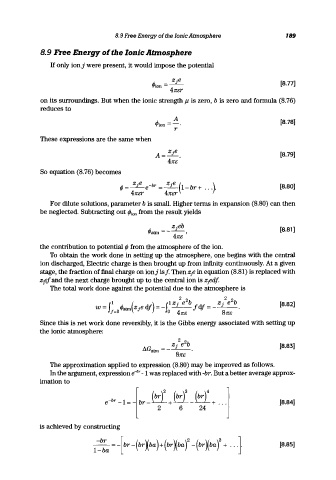
                If only ion j  were present, it would impose the potential
                                                     z·e
                                               A.   _   J                            [8.77]
                                               'I'ion  - 4ner
             on its surroundings. But when the ionic strength J1  is zero, b is zero and formula (8.76)
             reduces to
                                                     A
                                                tPion  =-.                           [8.78]
                                                     r
             These expressions are the same when

                                                A= zje.                              [8.79]
                                                   4ne
             So equation (8.76) becomes
                                     A. =  Z je  -br =  Z je (1- b   )               [8.80]
                                     'I'     e             r+  ....
                                        4ner      4ner
                For dilute solutions, parameter b is small. Higher terms in expansion (8.80) can then
             be neglected. Subtracting out tPion from the result yields

                                             tP   - _ zjeb                           [8.81]
                                              attn  -  4ne'
             the contribution to potential ¢ from the atmosphere of the ion.
                To obtain the work done in setting up the atmosphere, one begins with the central
             ion discharged, Electric charge is then brought up from infinity continuously. At a given
             stage, the fraction of final charge on ionj is! Then zJe in equation (8.81) is replaced with
             zjej and the next charge brought up to the central ion is zJed!
                The total work done against the potential due to the atmosphere is

                                                                      2
                                               )
                                         (
                              W=  f l   tPatmzjeq[  =- Ilz.2e2b   z.2e b  .          [8.82]
                                                     _J __ jdj= __ J __
                                  /=0              0  4ne           8ne
             Since this is net work done reversibly, it is the Gibbs energy associated with setting up
             the ionic atmosphere:
                                                       2  2
                                            ilG atm  =_ Zj  e b.                     [8.83]
                                                      8ne
                The approximation applied to expression (8.80) may be improved as follows.
                In the argument, expression e-Or - 1 was replaced with -br. But a better average approx-
             imation to


                                                                                     [8.84]


             is achieved by constructing


                                                                                     [8.85]

