


Page 83 - Modern physical chemistry
P. 83
72                          The First Law for Energy


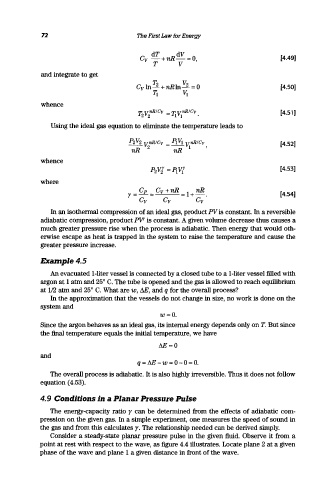
                                               dT     dV
                                           Cv  -+nR-=O,                              [4.49]
                                               T       V
             and integrate to get

                                                                                     [4.50]

             whence
                                          T2 V nR1C V  = 11 V1nR1CV •                [4.51 ]
                                             2
                Using the ideal gas equation to eliminate the temperature leads to

                                                                                     [4.52]


             whence
                                                                                     [4.53]
             where
                                       r = C p  = Cv + nR = 1 + nR.                  [4.54]
                                           Cv     Cv        Cv
                In an isothermal compression of an ideal gas, product PV is constant. In a reversible
             adiabatic compression, product PVY is constant. A given volume decrease thus causes a
             much greater pressure rise when the process is adiabatic. Then energy that would oth-
             erwise escape as heat is trapped in the system to raise the temperature and cause the
             greater pressure increase.

             Example 4.5

                An evacuated I-liter vessel is connected by a closed tube to a I-liter vessel filled with
             argon at 1 atm and 25° C. The tube is opened and the gas is allowed to reach equilibrium
             at 112 atm and 25° C.  What are w, fiE, and q for the overall process?
                In the approximation that the vessels do not change in size, no work is done on the
             system and
                                                 W=O.
             Since the argon behaves as an ideal gas, its internal energy depends only on T. But since
             the final temperature equals the initial temperature, we have


             and
                                          q = fiE - W = 0 - 0 = O.

                The overall process is adiabatic. It is also highly irreversible. Thus it does not follow
             equation (4.53).

             4.9 Conditions in a Planar Pressure Pulse
                The energy-capacity ratio y can be determined from the effects of adiabatic com-
             pression on the given gas. In a simple experiment, one measures the speed of sound in
             the gas and from this calculates y. The relationship needed can be derived simply.
                Consider a steady-state planar pressure pulse in the given fluid.  Observe it from a
             point at rest with respect to the wave, as figure 4.4 illustrates. Locate plane 2 at a given
             phase of the wave and plane 1 a given distance in front of the wave.

