


Page 86 - Modern physical chemistry
P. 86
4.11 Relating Differentials and Partial Derivatives     75

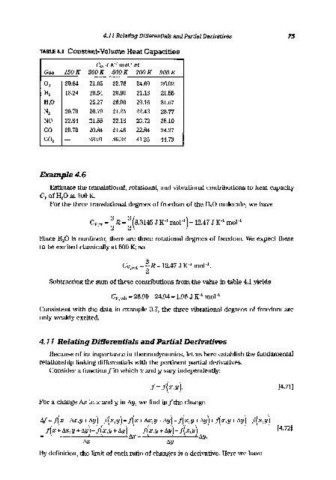
             TABLE 4.1  Constant-Volume Heat Capacities
                              Cv , J Kl rrwt 1  at
              Gas   150K  300K  500K  700K  900K
              O 2    20.84   21.05   22.76   24.69   26.02
              H2     18.24   20.54   20.96   21.13   21.55
              H 2 O   -     25.27   26.90   29.16   31.67
              N2     20.79   20.79   21.25   22.43   23.77
              NO     22.84   21.55   22.18   23.72   25.10
              CO     20.79   20.84   21.46   22.84   24.27
              CO2   -       28.91   36.32   41.25   44.73


             Example 4.6
                Estimate the translational, rotational, and vibrational contributions to heat capacity
             Cv of H 20  at 500 K.
                For the three translational degrees of freedom of the H 20  molecule, we have

                            Cv  tr = ~R =~(8.3145 J K· 1  mOI- 1 )= 12.47 J K- 1  mol- 1 .
                              ,   2    2
             Since H20  is nonlinear, there are three rotational degrees of freedom. We  expect these
             to be excited classically at 500 K;  so

                                      Cv rot = ~R = 12.47 J K- 1  mol- 1 .
                                        ,    2
                Subtracting the sum of these contributions from the value in table 4.1 yields

                                  CV,vib = 26.90 - 24.94 = 1.96 J K"l mOrl.
             Consistent with the data in example 3.7, the three vibrational degrees of freedom are
             only weakly excited.


             4. 11  Relating Differentials and Partial Derivatives

                Because of its importance in thermodynamics, let us here establish the fundamental
             relationship linking differentials with the pertinent partial derivatives.
                Consider a functionjin which x and y vary independently:
                                               j = j{X,y).                           [4.71]


             For a change tlx in x and y in !J.y, we find injthe change

             ~f = f(x+ ~,y + ~y)- f(x,y) = f(X +~,y + ~y)- f(X,y+ ~y)+ f(X,Y+ ~y)- f(X,y)
               f(X+~,y+~y)- f(X,y+~y)       f(X,y+~y)- f{X,y)                        [4.72]
             =                          ~+                   ~y.
                          ~                        ~y
             By definition, the limit of each ratio of changes is a derivative. Here we have

