


Page 89 - Modern physical chemistry
P. 89
18                           The First Law for Energy

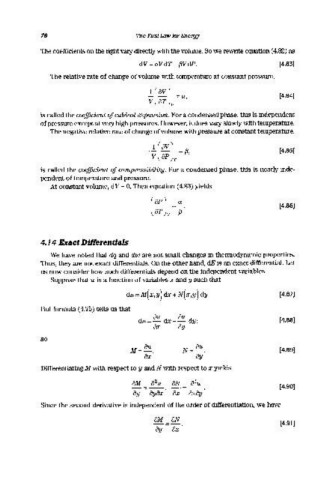
             The coefficients on the right vary directly with the volume. So we rewrite equation (4.82) as
                                           dV =aVdT- ,8VdP.                          [4.83J

                The relative rate of change of volume with temperature at constant pressure,

                                              1 [av)  =a,                            [4.84J
                                              V  aT  p
             is called the coe.fficient of cubical expansion. For a condensed phase, this is independent
             of pressure except at very high pressures. However, it does vary slowly with temperature.
                The negative relative rate of change of volume with pressure at constant temperature,


                                             -~ [ ~~)T =,8,                          [4.85J

             is called the coe.fficient of compressibility. For a condensed phase, this is nearly inde-
             pendent of temperature and pressure.
                At constant volume, dV = O.  Then equation (4.83) yields

                                                       a                             [4.86J
                                                       ,8


             4. 14 Exact Differentials
                We have noted that dq and dw are not small changes in thermodynamic properties.
             Thus, they are not exact differentials. On the other hand, dE is an exact differential. Let
             us now consider how such differentials depend on the independent variables.
                Suppose that u is a function of variables x and y such that
                                       du = M(X,y) dx+N(x,y) dy.                     [4.87J

             But formula (4.75) tells us that
                                               au
                                                       au
                                           du=- dx+- dy;                             [4.88J
                                               ax      ay
             so
                                        M=au            N=au.                        [4.89J
                                            ax'             ay
             Differentiating M with respect to y and N with respect to x yields

                                         aM  a 2u  aN  a 2u
                                        -=--, -=--                                   [4.90J
                                         ay  ayax  ax  axay
             Since the second derivative is independent of the order of differentiation, we have

                                               aM  aN
                                               -=-                                   [4.91 J
                                                ay  ax

