


Page 94 - Modern physical chemistry
P. 94
References                               83


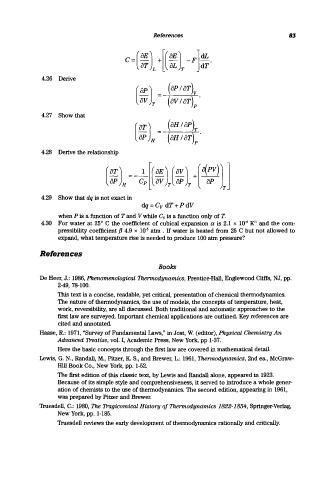
                                       c=[aE)  +[[aE)  _F]dL
                                           aT  L  aL  T  dT'

              4.26  Derive


              4.27  Show that
                                                   (aH / ap)T
                                                   (aH / aT)p


              4.28  Derive the relationship


                                 [ aT)  _  1 [raE)  [av)  [«PV)ll
                                                           +
                                  ap  H  - - C p av  T ap  T  -ap- T
              4.29  Show that dq is not exact in
                                            dq =Cv dT+PdV

                   when P is a function of T and V while Cv is a function only of T.
             4.30  For water at 25° C the coefficient of cubical expansion a  is 2.1  x  10-4  Kl and the com-
                   pressibility coefficient f3  4.9  x  10- 6  atm . If water is heated from 25  C but not allowed to
                  expand, what temperature rise is needed to produce 100 atm pressure?

             References
                                                 Books

             De Heer, J.: 1986, Phenomenological Thermodynamics, Prentice-Hall, Englewood Cliffs, NJ, pp.
                  2-49,  78-100.
                  This text is a concise, readable, yet critical, presentation of chemical thermodynamics.
                  The nature of thermodynamics, the use of models, the concepts of temperature, heat,
                  work, reversibility, are all discussed. Both traditional and axiomatic approaches to the
                  first law are surveyed. Important chemical applications are outlined. Key references are
                  cited and annotated.
             Haase, R.:  1971, "Survey of Fundamental Laws," in Jost, W.  (editor), Physical Chemistry An
                  Advanced Treatise, vol. I, Academic Press, New York, pp 1-37.
                  Here the basic concepts through the first law are covered in mathematical detail.
             Lewis, G.  N., Randall, M.,  Pitzer, K  S., and Brewer, L.:  1961, Thermodynamics, 2nd ea., McGraw-
                  Hill Book Co., New York, pp. 1-52.
                  The first edition of this classic text, by Lewis and Randall alone, appeared in 1923.
                  Because of its simple style and comprehensiveness, it served to introduce a whole gener-
                  ation of chemists to the use of thermodynamics. The second edition, appearing in 1961,
                  was prepared by Pitzer and Brewer.
             Truesdell, C.:  1980,  The Tragicomical History oj Thermodynamics 1822-1854, Springer-Verlag,
                  New York, pp. 1-185.
                  Truesdell reviews the early development of thermodynamics rationally and critically.

