


Page 91 - Modern physical chemistry
P. 91
80                           The First Law for Energy

                                  ~)
                                            -
                                 ( On       -V                                       [4.99]
                                              A,
                                    A  T,P,nB
             Coefficient VA  is called the partial molar volume of A,  coefficient VB  the partial molar
             volume of B, in the solution.
                Next, divide the overall equation (4.98) by dn to get

                                         dV _ V- dnA   -V; dnB                      [4.100]
                                         --    A--+  B--'
                                          dn      dn      dn
             Then let the system be built up from nothing at constant temperature, pressure, and
             concentrations. We have
                              dnA   nA          dnB  = nB         dV  V
                              --=-                                                  [4.101]
                               dn    n           dn    n          dn   n
             and equation (4.100) becomes

                                                                                    [4.102]

             whence
                                                                                    [4.103]
             The partial molar volume of a constituent is the contribution of that constituent per mole
             to the total volume. When the solution is homogeneous, this contribution depends on T,
             P, and the concentrations. It is independent of the total number of moles n. Thus, it is
             an intensive property.
                In equation (4.102), nAln is the mole fraction of A, XA , while naln is the mole fraction
             of B, X B • Thus, the equation can be rewritten as

                                                                                    [4.104]

             But since
                                                                                    [4.105]
             we have
                                          V-(--)
                                          n  =VA +  VB-VA  X B·                     [4.106]
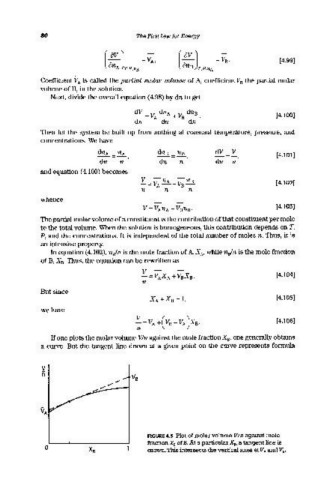
                If one plots the molar volume Vln against the mole fraction X B, one generally obtains
             a curve.  But the tangent line drawn at a given point on the curve represents formula


             V
              n


                                             FIGURE 4.5  Plot of molar volume Vln against mole
              o                              fraction X B of B. At a particular X B • a tange~t line i~
                                             drawn. This intersects the vertical axes at VA and VB'

