


Page 93 - Modern physical chemistry
P. 93
82                           The First Law for Energy

              4.7  Calculate!1E and Ml of 100 g helium when it is heated from 0° to 100° C, assuming it is an
                   ideal gas with a Cy  of 3/2R per mole.
              4.8  An ideal gas with Cy  equal to 512R per mole initially filled 2.24 1 at 1.00 atm and 0° C,  and
                  finally filled 4.48 1 at 2.00 atm, Calculate q and w if the process was (a) a constant-volume
                   increase of pressure to 2.00 atm followed by a constant-pressure increase of volume to 4.48
                   1,  (b) a  constant-pressure increase of volume to 4.48  1 followed by a  constant-volume
                   increase of pressure to 2.00 atm.
              4.9  If 0.810 mol helium was compressed reversibly and adiabatically from 40.0 1 at 0° C to 30.0
                   1, what was the temperature increase? What was !1E?
             4.10  Calculate the speed of sound in hydrogen at 25° C.
             4.11  How much do the (a) translational, (b) rotational, (c) vibrational degrees of freedom con-
                   tribute to the heat capacity of carbon dioxide at 300 K where Cv is 28.91 J Kl moll, if CO 2
                   is a linear molecule?
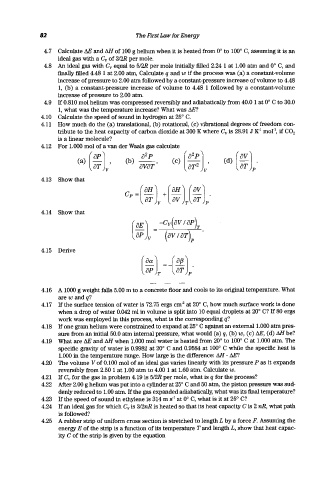
             4.12  For 1.000 mol of a van der Waals gas calculate
                             ap)            a2 p
                            raT  v'    (b)  avaT'                   (d)  [av)  .
                        (a)                          (c)
                                                                         aT  p
             4.13  Show that
                                       c  _[aH)  +[aH)  [av)
                                        p - aT  v  av  T aT  p.

             4.14  Show that
                                                 -cv(av / ap)T

                                                   (av / aT)p

             4.15  Derive


             4.16  A 1000 g weight falls 5.00 m to a concrete floor and cools to its original temperature. What
                  are w and q?
             4.17  If the surface tension of water is 72.75 ergs cm· 2  at 20° C, how much surface work is done
                   when a drop of water 0.042 ml in volume is split into 10 equal droplets at 20° C? If 80 ergs
                   work was employed in this process, what is the corresponding q?
             4.18  If one gram helium were constrained to expand at 25° C against an external 1.000 atm pres-
                  sure from an initial 50.0 atm internal pressure, what would (a) q, (b) w, (c)!1E, (d) Ml be?
             4.19  What are !1E and Ml when 1.000 mol water is heated from 20° to 100° C at 1.000 atm. The
                  specific gravity of water is 0.9982 at 20° C and 0.9584 at 100° C while the specific heat is
                   1.000 in the temperature range. How large is the difference: Ml - !1E?
             4.20  The volume V of 0.100 mol of an ideal gas varies linearly with its pressure P as it expands
                   reversibly from 2.50 1 at 1.00 atm to 4.00 1 at 1.60 atm. Calculate w.
             4.21  If Cv for the gas in problem 4.19 is 512R per mole, what is q for the process?
             4.22  After 2.00 g helium was put into a cylinder at 25° C and 50 atm, the piston pressure was sud-
                  denly reduced to 1.00 atm. If the gas expanded adiabatically, what was its final temperature?
             4.23  If the speed of sound in ethylene is 314 m S·l at 0° C, what is it at 25° C?
             4.24  If an ideal gas for which Cv is 3/2nR is heated so that its heat capacity Cis 2 nR, what path
                   is followed?
             4.25  A rubber strip of uniform cross section is stretched to length L by a force F. Assuming the
                  energy E of the strip is a function of its temperature T and length L, show that heat capac-
                   ity C of the strip is given by the equation

