


Page 87 - Modern physical chemistry
P. 87
76                           The First Law [or Energy


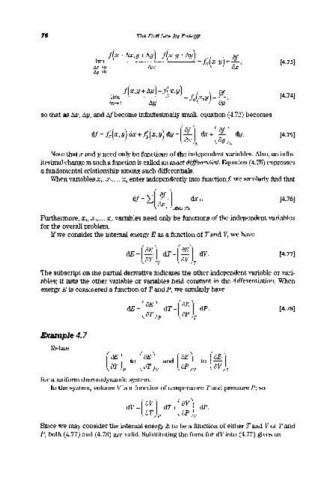
                              .   f(X+Ax,Y+L1Y)-f(x,Y+L1Y) _  '(    )_ of
                              hm                            -fx X,Y  --,             [4.73]
                             ~~O             Ax                        ~
                             l!.y~O

                                   .   f( x, Y + L1Y) - f( x, Y)  _  ' (   ) _ of
                                  hm                    -fy X,Y  --,                 [4.74]
                                  l!.y~O      L1y                  oy
             so that as Ax, L1y,  and L1fbecome infinitesimally small, equation (4.72) becomes


                                                                                     [4.75]

                Note that x and Y need only be functions of the independent variables. Also, an infin-
             itesimal change in such a function is called an exact differential. Equation (4.75) expresses
             a fundamental relationship among such differentials.
                When variables X h  X2,""  xn enter independently into function!, we similarly find that
                                         df= L[~)                                    [4.76]
                                                 ax·      dxj •
                                                   J  other x's
             Furthermore, X h  X2,'''' xn variables need only be functions of the independent variables
             for the overall problem.
                If we consider the internal energy E as a function of T and V, we have

                                       dE=[OE)  dT+[OE)  dV.                         [4.77]
                                             aT  v      oV  T
             The subscript on the partial derivative indicates the other independent variable or vari-
             ables; it lists the other variable or variables held constant in the differentiation. When
             energy E is considered a function of T and P, we similarly have

                                       dE=(OE)  dT+(aE)  dP.                         [4.78]
                                             aT  p      oP  T

             Example 4.7
                Relate
                                 (~;)p to (~;)v and (~;)T to (~~)T


             for a uniform thermodynamic system.
                In the system, volume V is a function of temperature T and pressure P; so


                                       dV =(OV)  dT+(OV)  dP.
                                             aT  p      oP  T
             Since we may consider the internal energy E to be a function of either T and Vor T and
             P, both (4.77) and (4.78) are valid. Substituting the form for dV into (4.77) gives us

