


Page 181 - New Trends In Coal Conversion
P. 181
144                                            New Trends in Coal Conversion


                                                          Lower nitrogen
                                                             content

                                                          Higher volatile
                                       Pre-combustion
                                                             content
                                                           Finer grinding


                                                            Low NO x
                                                             burners


                                                           Over fire air
                    NO removal          In-combustion       Flue gas
                      x
                    technologies                           recirculation
                                                          Burners out of
                                                             service

                                                          Low excess air


                                                             Selective
                                                           non-catalytic
                                                            reduction
                                       Post-combustión
                                                             Selective
                                                             catalytic
                                                            reduction
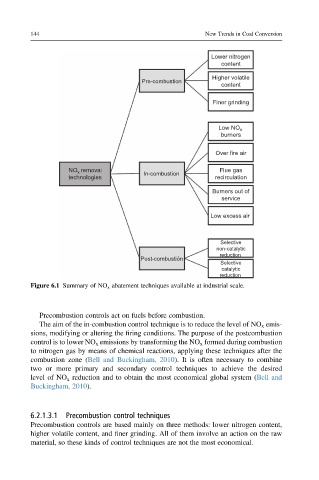
         Figure 6.1 Summary of NO x abatement techniques available at industrial scale.


            Precombustion controls act on fuels before combustion.
            The aim of the in-combustion control technique is to reduce the level of NO x emis-
         sions, modifying or altering the firing conditions. The purpose of the postcombustion
         control is to lower NO x emissions by transforming the NO x formed during combustion
         to nitrogen gas by means of chemical reactions, applying these techniques after the
         combustion zone (Bell and Buckingham, 2010). It is often necessary to combine
         two or more primary and secondary control techniques to achieve the desired
         level of NO x reduction and to obtain the most economical global system (Bell and
         Buckingham, 2010).


         6.2.1.3.1 Precombustion control techniques
         Precombustion controls are based mainly on three methods: lower nitrogen content,
         higher volatile content, and finer grinding. All of them involve an action on the raw
         material, so these kinds of control techniques are not the most economical.

