


Page 183 - New Trends In Coal Conversion
P. 183
146                                            New Trends in Coal Conversion

         boilers, but higher CO emission and O 2 imbalance results are problems derived from
         their operation. However, these problems could be minimized by the appropriate selec-
         tion of burners (Bell and Buckingham, 2010).
            Low excess air. The use of low excess air in the combustion is an economical alter-
         native for reducing NO x because it is not necessary to acquire new hardware or to
         modify the existing facilities to implement this control technology. Moreover, there
         are many authors who think that low excess air should be part of a normal furnace
         operation, requiring only process control tuning to obtain the optimal operation point
         (Bell and Buckingham, 2010).


         6.2.1.3.3 Postcombustion control techniques
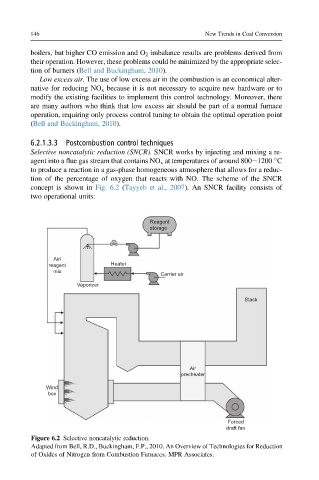
         Selective noncatalytic reduction (SNCR). SNCR works by injecting and mixing a re-

         agent into a flue gas stream that contains NO x at temperatures of around 800e1200 C
         to produce a reaction in a gas-phase homogeneous atmosphere that allows for a reduc-
         tion of the percentage of oxygen that reacts with NO. The scheme of the SNCR
         concept is shown in Fig. 6.2 (Tayyeb et al., 2007). An SNCR facility consists of
         two operational units:


                                          Reagent
                                          storage


               Air/
              reagent          Heater
               mix
                                            Carrier air
                      Vaporizer
                                                                   Stack


                                                    Air
                                                  precheater
             Wind
              box


                                                               Forced
                                                              draft fan
         Figure 6.2 Selective noncatalytic reduction.
         Adapted from Bell, R.D., Buckingham, F.P., 2010. An Overview of Technologies for Reduction
         of Oxides of Nitrogen from Combustion Furnaces. MPR Associates.

