


Page 187 - New Trends In Coal Conversion
P. 187
150                                            New Trends in Coal Conversion

         6.2.2.2  SO x formation

         Anthropogenic SO 2 is mainly produced by the oxidation of the sulfur content during
         the combustion of fossil fuels and other materials in industrial processes and domestic
         activity, mainly related to the use of coal and heavy fuel oil as fuel. The sulfur content
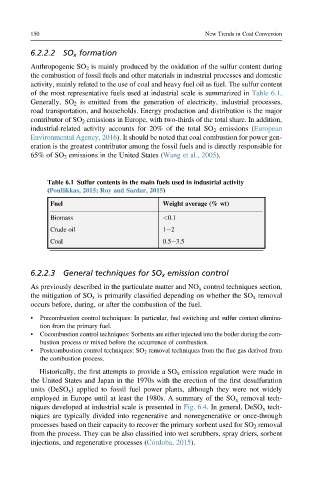
         of the most representative fuels used at industrial scale is summarized in Table 6.1.
         Generally, SO 2 is emitted from the generation of electricity, industrial processes,
         road transportation, and households. Energy production and distribution is the major
         contributor of SO 2 emissions in Europe, with two-thirds of the total share. In addition,
         industrial-related activity accounts for 20% of the total SO 2 emissions (European
         Environmental Agency, 2016). It should be noted that coal combustion for power gen-
         eration is the greatest contributor among the fossil fuels and is directly responsible for
         65% of SO 2 emissions in the United States (Wang et al., 2005).


              Table 6.1 Sulfur contents in the main fuels used in industrial activity
              (Poullikkas, 2015; Roy and Sardar, 2015)

               Fuel                          Weight average (% wt)
               Biomass                       <0.1
               Crude oil                     1e2
               Coal                          0.5e3.5


         6.2.2.3  General techniques for SO x emission control
         As previously described in the particulate matter and NO x control techniques section,
         the mitigation of SO x is primarily classified depending on whether the SO x removal
         occurs before, during, or after the combustion of the fuel.
         •  Precombustion control techniques: In particular, fuel switching and sulfur content elimina-
            tion from the primary fuel.
         •  Cocombustion control techniques: Sorbents are either injected into the boiler during the com-
            bustion process or mixed before the occurrence of combustion.
         •  Postcombustion control techniques: SO 2 removal techniques from the flue gas derived from
            the combustion process.
            Historically, the first attempts to provide a SO x emission regulation were made in
         the United States and Japan in the 1970s with the erection of the first desulfuration
         units (DeSO x ) applied to fossil fuel power plants, although they were not widely
         employed in Europe until at least the 1980s. A summary of the SO x removal tech-
         niques developed at industrial scale is presented in Fig. 6.4. In general, DeSO x tech-
         niques are typically divided into regenerative and nonregenerative or once-through
         processes based on their capacity to recover the primary sorbent used for SO 2 removal
         from the process. They can be also classified into wet scrubbers, spray driers, sorbent
         injections, and regenerative processes (C  ordoba, 2015).

