


Page 190 - New Trends In Coal Conversion
P. 190
Technologies for control of sulfur and nitrogen compounds and particulates  153


              Flue gas
              draft fan
                                     Reheater
                                                To stack
                            Absorber
                   Dust
                   pre-
                  treatment
                   venturi
                                                                         SO
            Process                                                        3
            water                                                       Condensate
                                               Evaporator    Crystallizer
                                   Cooling                                 split
                             Rich   water                                 Cooling
                            solvent                                       water
                 Ash to landfill
                            storage
                             tank
                                                                       Sodium
                                                      Particulate matter
                                              Feed      device
                                              cooler               Feed slurry
                                                                     tank
                    Glycol
                         Cooler
                                                       Sulfate solid
                                                 Dryer   purge
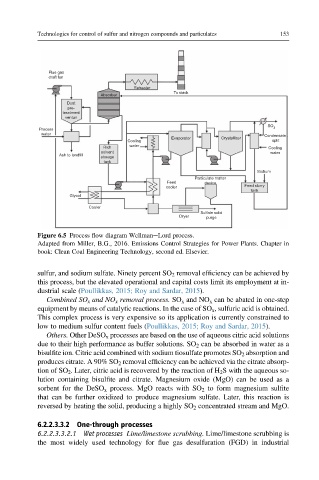
           Figure 6.5 Process flow diagram WellmaneLord process.
           Adapted from Miller, B.G., 2016. Emissions Control Strategies for Power Plants. Chapter in
           book: Clean Coal Engineering Technology, second ed. Elsevier.


           sulfur, and sodium sulfate. Ninety percent SO 2 removal efficiency can be achieved by
           this process, but the elevated operational and capital costs limit its employment at in-
           dustrial scale (Poullikkas, 2015; Roy and Sardar, 2015).
              Combined SO x and NO x removal process. SO x and NO x can be abated in one-step
           equipment by means of catalytic reactions. In the case of SO x , sulfuric acid is obtained.
           This complex process is very expensive so its application is currently constrained to
           low to medium sulfur content fuels (Poullikkas, 2015; Roy and Sardar, 2015).
              Others. Other DeSO x processes are based on the use of aqueous citric acid solutions
           due to their high performance as buffer solutions. SO 2 can be absorbed in water as a
           bisulfite ion. Citric acid combined with sodium tiosulfate promotes SO 2 absorption and
           produces citrate. A 90% SO 2 removal efficiency can be achieved via the citrate absorp-
           tion of SO 2 . Later, citric acid is recovered by the reaction of H 2 S with the aqueous so-
           lution containing bisulfite and citrate. Magnesium oxide (MgO) can be used as a
           sorbent for the DeSO x process. MgO reacts with SO 2 to form magnesium sulfite
           that can be further oxidized to produce magnesium sulfate. Later, this reaction is
           reversed by heating the solid, producing a highly SO 2 concentrated stream and MgO.

           6.2.2.3.3.2  One-through processes
           6.2.2.3.3.2.1 Wet processes Lime/limestone scrubbing. Lime/limestone scrubbing is
           the most widely used technology for flue gas desulfuration (FGD) in industrial

