


Page 176 - Optical Communications Essentials
P. 176
Active Optical Components


          166  Chapter Ten


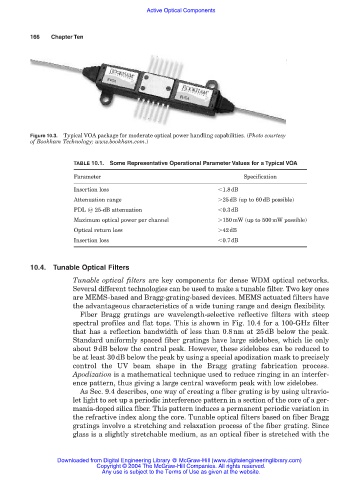
          Figure 10.3. Typical VOA package for moderate optical power handling capabilities. (Photo courtesy
          of Bookham Technology; www.bookham.com.)


                      TABLE 10.1. Some Representative Operational Parameter Values for a Typical VOA
                      Parameter                                      Specification

                      Insertion loss                           1.8dB
                      Attenuation range                        25dB (up to 60dB possible)
                      PDL @ 25-dB attenuation                  0.3dB
                      Maximum optical power per channel        150mW (up to 500mW possible)
                      Optical return loss                      42dB
                      Insertion loss                           0.7dB


          10.4. Tunable Optical Filters

                      Tunable optical filters are key components for dense WDM optical networks.
                      Several different technologies can be used to make a tunable filter. Two key ones
                      are MEMS-based and Bragg-grating-based devices. MEMS actuated filters have
                      the advantageous characteristics of a wide tuning range and design flexibility.
                        Fiber Bragg gratings are wavelength-selective reflective filters with steep
                      spectral profiles and flat tops. This is shown in Fig. 10.4 for a 100-GHz filter
                      that has a reflection bandwidth of less than 0.8nm at 25dB below the peak.
                      Standard uniformly spaced fiber gratings have large sidelobes, which lie only
                      about 9dB below the central peak. However, these sidelobes can be reduced to
                      be at least 30dB below the peak by using a special apodization mask to precisely
                      control the UV beam shape in the Bragg grating fabrication process.
                      Apodization is a mathematical technique used to reduce ringing in an interfer-
                      ence pattern, thus giving a large central waveform peak with low sidelobes.
                        As Sec. 9.4 describes, one way of creating a fiber grating is by using ultravio-
                      let light to set up a periodic interference pattern in a section of the core of a ger-
                      mania-doped silica fiber. This pattern induces a permanent periodic variation in
                      the refractive index along the core. Tunable optical filters based on fiber Bragg
                      gratings involve a stretching and relaxation process of the fiber grating. Since
                      glass is a slightly stretchable medium, as an optical fiber is stretched with the


                 Downloaded from Digital Engineering Library @ McGraw-Hill (www.digitalengineeringlibrary.com)
                            Copyright © 2004 The McGraw-Hill Companies. All rights reserved.
                              Any use is subject to the Terms of Use as given at the website.

