


Page 209 - Packed bed columns for absorption, desorption, rectification and direct heat transfer
P. 209
199


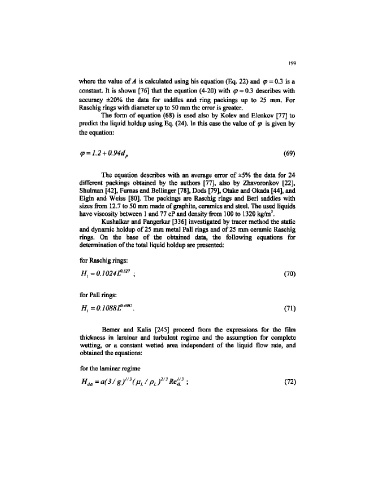
                           where the value of A is calculated using his equation (Eq. 22) and ip = 0.3 is a
                           constant. It is shown [76] that the equation (4-20) with (p = 0.3 describes with
                           accuracy ±20% the date for saddles and ring packings up to 25 mm. For
                           Raschig rings with diameter up to 50 mm the error is greater.
                                  The form of equation (68) is used also by Kolev and Elenkov [77] to
                           predict the liquid holdup using Eq, (24). In this case the value of tp is given by
                           the equation:


                           tp = 1.2 + 0.944 p                                                (69)


                                  The equation describes with an average error of ±5% the data for 24
                           different packings obtained by the authors [77], also by Zhavoronkov [22],
                           Shulman [42], Fumas and Bellinger [78], Dods [79], Otake and Okada [44], and
                           Elgin and Weiss [80]. The packings are Raschig rings and Berl saddles with
                           sizes from 12.7 to 50 mm made of graphite, ceramics and steel. The used liquids
                                                                                         3
                           have viscosity between 1 and 77 cP and density from 100 to 1320 kg/m .
                                  Kushalkar and Pangerkar [336] investigated by tracer method the static
                           and dynamic holdup of 25 mm metol Pall rings and of 25 mm ceramic Raschig
                           rings. On the base of the obtained data, the following equations for
                           determination of the total liquid holdup are presented:

                           for Raschig rings:
                                          m
                           H t =0.10241?  ;                                                  (70)


                           for Pall rings:

                           H t=0.108SL 0m7 .                                                 (71)


                                  Bemer and Kalis [245] proceed from the expressions for the film
                           thickness in laminar and turbulent regime and the assumption for complete
                           wetting, or a constant wetted area independent of the liquid flow rate, and
                           obtained the equations:

                           for the laminar regime
                                                        n
                                                 l/3
                           H d0        =a(3/g) ( J 4?
                                                    ML

