


Page 183 - Partition & Adsorption of Organic Contaminants in Environmental Systems
P. 183
174   CONTAMINANT SORPTION TO SOILS AND NATURAL SOLIDS

                        20
                                            1, 2, 3-Trichlorobenzene (24°C)
                       (mg/L)


                        15
                       150
                     Apparent Solute Solubility  100  2, 4, 4'-PCB (24°C)


                        10
                       (µg/L)


                         5                  2, 4, 5, 2', 5'-PCB (24°C)

                                            p, p' -DDT (23°C)

                         0
                          0       20       40      60       80      100
                               Concentration of Polyacrylic Acid, X (mg/L)
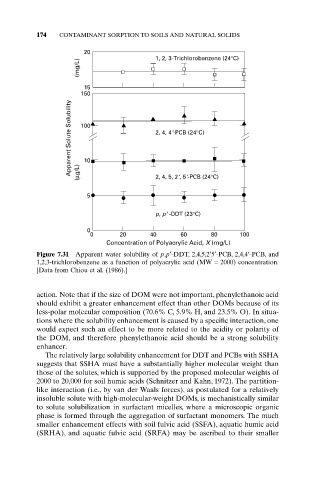
           Figure 7.31 Apparent water solubility of p,p¢-DDT, 2,4,5,2¢5¢-PCB, 2,4,4¢-PCB, and
           1,2,3-trichlorobenzene as a function of polyacrylic acid (MW = 2000) concentration.
           [Data from Chiou et al. (1986).]


           action. Note that if the size of DOM were not important, phenylethanoic acid
           should exhibit a greater enhancement effect than other DOMs because of its
           less-polar molecular composition (70.6% C, 5.9% H, and 23.5% O). In situa-
           tions where the solubility enhancement is caused by a specific interaction, one
           would expect such an effect to be more related to the acidity or polarity of
           the DOM, and therefore phenylethanoic acid should be a strong solubility
           enhancer.
              The relatively large solubility enhancement for DDT and PCBs with SSHA
           suggests that SSHA must have a substantially higher molecular weight than
           those of the solutes, which is supported by the proposed molecular weights of
           2000 to 20,000 for soil humic acids (Schnitzer and Kahn, 1972). The partition-
           like interaction (i.e., by van der Waals forces), as postulated for a relatively
           insoluble solute with high-molecular-weight DOMs, is mechanistically similar
           to solute solubilization in surfactant micelles, where a microscopic organic
           phase is formed through the aggregation of surfactant monomers. The much
           smaller enhancement effects with soil fulvic acid (SSFA), aquatic humic acid
           (SRHA), and aquatic fulvic acid (SRFA) may be ascribed to their smaller

