


Page 179 - Partition & Adsorption of Organic Contaminants in Environmental Systems
P. 179
170   CONTAMINANT SORPTION TO SOILS AND NATURAL SOLIDS
           in which K* and K oc may be substituted for K* and K om, respectively, if K* d
                                                     om
                     oc
           and K d are normalized to soil (or sediment) organic carbon content (f oc).
              The magnitude of  K dom (or  K doc), from the standpoint of DOM, should
           depend on the polarity and molecular size of DOM. For truly dissolved organic
           matter (not suspended organic matter), the DOM molecules must in principle
           be sufficiently large and must possess a sizable intramolecular nonpolar
           moiety in order to promote partitionlike interaction with the solute. A dis-
           solved low-molecular-weight organic matter (e.g., an organic solvent) is not
           expected to be equally effective for promoting this type of interaction because
           of its size limitation. For the solutes, the important properties for a large
           solubility enhancement are very low water solubility and significant com-
           patibility with the organic phase.
              A critical analysis of the functional relationship of K dom (or K doc) with solute
           S w and with the source and composition of DOM in truly dissolved form was
           given by Chiou et al. (1986, 1987) using a series of solutes with vastly differ-
           ent  S w values and of DOMs with varied compositions and structures. The
           solutes used and their  S w values at room temperature are: p,p¢-DDT, S w =
           5.5mg/L; 2,4,5,2¢,5¢-PCB, S w = 10mg/L; 2,4,4¢-PCB, S w = 115mg/L; lindane, S w =
           7.8mg/L; and 1,2,3-trichlorobenzene (TCB), S w = 16.3mg/L. The various
           DOMs used are: Sanhedrin soil humic acid (SSHA), Sanhedrin soil fulvic acid
           (SSFA), Suwannee River humic acid (SRHA), and Suwannee River fulvic acid
           (SRFA), extracted from soil and stream, and human-made phenylethanoic
           acid and polyacrylic acid. The high purities of extracted natural DOM samples
           provide sufficiently accurate elemental data (shown in Table 7.14) as indices
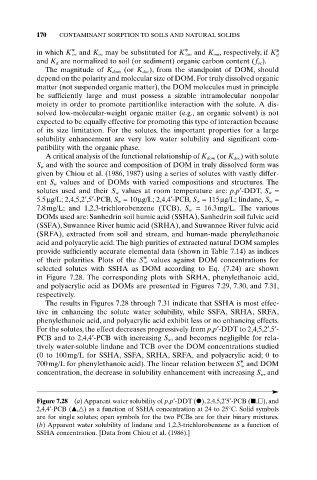
           of their polarities. Plots of the  S* values against DOM concentrations for
                                         w
           selected solutes with SSHA as DOM according to Eq. (7.24) are shown
           in Figure 7.28. The corresponding plots with SRHA, phenylethanoic acid,
           and polyacrylic acid as DOMs are presented in Figures 7.29, 7.30, and 7.31,
           respectively.
              The results in Figures 7.28 through 7.31 indicate that SSHA is most effec-
           tive in enhancing the solute water solubility, while SSFA, SRHA, SRFA,
           phenylethanoic acid, and polyacrylic acid exhibit less or no enhancing effects.
           For the solutes, the effect decreases progressively from p,p¢-DDT to 2,4,5,2¢,5¢-
           PCB and to 2,4,4¢-PCB with increasing S w, and becomes negligible for rela-
           tively water-soluble lindane and TCB over the DOM concentrations studied
           (0 to 100mg/L for SSHA, SSFA, SRHA, SRFA, and polyacrylic acid; 0 to
           700mg/L for phenylethanoic acid). The linear relation between S* and DOM
                                                                    w
           concentration, the decrease in solubility enhancement with increasing S w , and


           Figure 7.28 (a) Apparent water solubility of p,p¢-DDT ( ), 2,4,5,2¢5¢-PCB ( , ), and
           2,4,4¢-PCB ( , ) as a function of SSHA concentration at 24 to 25°C. Solid symbols
           are for single solutes; open symbols for the two PCBs are for their binary mixtures.
           (b) Apparent water solubility of lindane and 1,2,3-trichlorobenzene as a function of
           SSHA concentration. [Data from Chiou et al. (1986).]

