


Page 232 - Partition & Adsorption of Organic Contaminants in Environmental Systems
P. 232
UPTAKE BY PLANT SEEDLINGS FROM SOIL    223

            root water that increases the activity (and thus decreases the solubility) of
            neutral compounds (Trapp, 2000). However, the expected high a pt value (1.02)
            for equally polar and soluble oxamyl in Table 8.1 suggests that an effect other
            than membrane barrier and ionic strength may be relevant. Overall, the results
            indicate that the concentrations of compounds with K ow £ 1000 in barley roots
            are reasonably close to equilibrium with external water after 24 to 48h; for
            compounds with K ow > 1000, accurate K lip values are required to determine the
            approach to equilibrium.


            8.5 UPTAKE BY PLANT SEEDLINGS FROM SOIL

            Although there are numerous reports in the literature on contaminant up-
            take by plants or crops from soils, only a few provide the corresponding soil
            contaminant levels; even in studies where the levels in soil are reported, the
            requisite data on the SOM (or K d) values are often not available. In other
            cases, the incorporation of contaminants into soils has not reached a stable
            condition, because either of insufficient time of incorporation or of instability
            of the compounds (e.g., large dissipation by vaporization). The following
            model calculations are performed for those systems that are considered to be
            relatively stable and where the data on SOM contents are reported.
              Trapp et al. (1990) measured the concentrations of a herbicide (atrazine)
            and other chlorinated hydrocarbons in barley seedlings (Hordeum vulgare)
            germinated from a contaminated soil. The crop uptake was separately
                                    14
            investigated for each of the  C-labeled contaminants in a closed aerated lab-
            oratory system. After the barley seedlings had been in contact with the soil
            for 1 week, plant and soil samples were taken for analysis of the parent com-
            pound and its metabolites in both soil and plants; however, the metabolites
            were not identified. The soil contained 2.06% organic carbon, or approxi-
            mately 3.5% in SOM, and was maintained at 20% water during the experi-
            ment. The measured concentrations of the parent compounds and their
            metabolites in both soil and plants (roots + shoots) are given in Table 8.2. For
            our model calculations, the concentrations in soil have also been normalized
            to the SOM.
              For whole barley seedlings, the authors assumed the composition to be
            87.5% water and 1% lipids. As before, we further assume that the remaining
            11.5% consists essentially of carbohydrates and cellulose, on which the con-
            taminants exhibit the same partition coefficients. With these assumptions
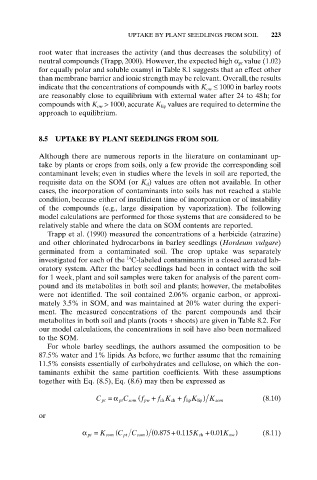
            together with Eq. (8.5), Eq. (8.6) may then be expressed as

                            C pt = a  pt C som ( f pw +  f K +  f K )  K som  (8.10)
                                             ch
                                                ch
                                                        lip
                                                     lip
            or
                                                            .
                        a pt =  K som C (  pt C som ) (0 875 0 115.  + .  K + 0 01 K ow )  (8.11)
                                                        ch

