


Page 238 - Partition & Adsorption of Organic Contaminants in Environmental Systems
P. 238
CONTAMINANT LEVELS IN AQUATIC PLANTS AND SEDIMENTS      229

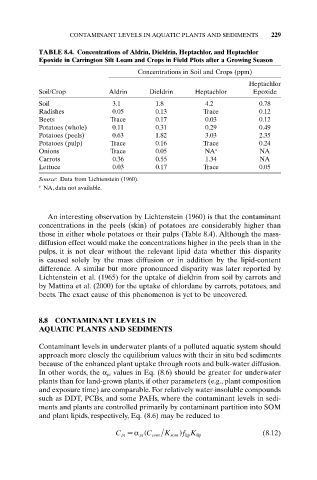
            TABLE 8.4. Concentrations of Aldrin, Dieldrin, Heptachlor, and Heptachlor
            Epoxide in Carrington Silt Loam and Crops in Field Plots after a Growing Season
                                       Concentrations in Soil and Crops (ppm)
                                                                      Heptachlor
            Soil/Crop          Aldrin     Dieldrin     Heptachlor      Epoxide
            Soil                3.1         1.8           4.2            0.78
            Radishes            0.05        0.13         Trace           0.12
            Beets               Trace       0.17          0.03           0.12
            Potatoes (whole)    0.11        0.31          0.29           0.49
            Potatoes (peels)    0.63        1.82          3.03           2.35
            Potatoes (pulp)     Trace       0.16         Trace           0.24
            Onions              Trace       0.05          NA a           NA
            Carrots             0.36        0.55          1.34           NA
            Lettuce             0.03        0.17         Trace           0.05

            Source: Data from Lichtenstein (1960).
            a
             NA, data not available.


              An interesting observation by Lichtenstein (1960) is that the contaminant
            concentrations in the peels (skin) of potatoes are considerably higher than
            those in either whole potatoes or their pulps (Table 8.4). Although the mass-
            diffusion effect would make the concentrations higher in the peels than in the
            pulps, it is not clear without the relevant lipid data whether this disparity
            is caused solely by the mass diffusion or in addition by the lipid-content
            difference. A similar but more pronounced disparity was later reported by
            Lichtenstein et al. (1965) for the uptake of dieldrin from soil by carrots and
            by Mattina et al. (2000) for the uptake of chlordane by carrots, potatoes, and
            beets. The exact cause of this phenomenon is yet to be uncovered.


            8.8 CONTAMINANT LEVELS IN
            AQUATIC PLANTS AND SEDIMENTS

            Contaminant levels in underwater plants of a polluted aquatic system should
            approach more closely the equilibrium values with their in situ bed sediments
            because of the enhanced plant uptake through roots and bulk-water diffusion.
            In other words, the a pt values in Eq. (8.6) should be greater for underwater
            plants than for land-grown plants, if other parameters (e.g., plant composition
            and exposure time) are comparable. For relatively water-insoluble compounds
            such as DDT, PCBs, and some PAHs, where the contaminant levels in sedi-
            ments and plants are controlled primarily by contaminant partition into SOM
            and plant lipids, respectively, Eq. (8.6) may be reduced to
                                 C pt  a ( C som  K som ) lip             (8.12)
                                                    f K lip
                                        pt

