


Page 239 - Partition & Adsorption of Organic Contaminants in Environmental Systems
P. 239
230   CONTAMINANT UPTAKE BY PLANTS FROM SOIL AND WATER

           or

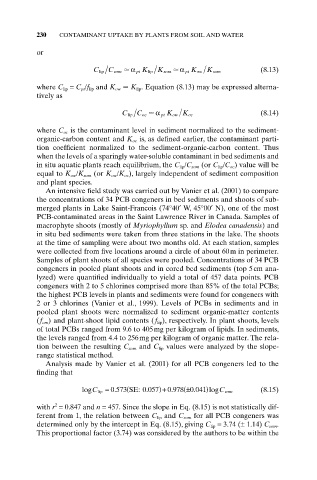
                               C som  a      K som  a                    (8.13)
                           C lip       pt  K lip    pt  K ow  K som
           where C lip = C pt/f lip and K ow   K lip. Equation (8.13) may be expressed alterna-
           tively as

                                       C oc  a                           (8.14)
                                   C lip      pt  K ow  K oc
           where C oc is the contaminant level in sediment normalized to the sediment-
           organic-carbon content and K oc is, as defined earlier, the contaminant parti-
           tion coefficient normalized to the sediment-organic-carbon content. Thus
           when the levels of a sparingly water-soluble contaminant in bed sediments and
           in situ aquatic plants reach equilibrium, the C lip/C som (or C lip/C oc) value will be
           equal to K ow/K som (or K ow/K oc), largely independent of sediment composition
           and plant species.
              An intensive field study was carried out by Vanier et al. (2001) to compare
           the concentrations of 34 PCB congeners in bed sediments and shoots of sub-
           merged plants in Lake Saint-Francois (74°40¢ W, 45°00¢ N), one of the most
           PCB-contaminated areas in the Saint Lawrence River in Canada. Samples of
           macrophyte shoots (mostly of Myriophyllum sp. and Elodea canadensis) and
           in situ bed sediments were taken from three stations in the lake. The shoots
           at the time of sampling were about two months old. At each station, samples
           were collected from five locations around a circle of about 60m in perimeter.
           Samples of plant shoots of all species were pooled. Concentrations of 34 PCB
           congeners in pooled plant shoots and in cored bed sediments (top 5cm ana-
           lyzed) were quantified individually to yield a total of 457 data points. PCB
           congeners with 2 to 5 chlorines comprised more than 85% of the total PCBs;
           the highest PCB levels in plants and sediments were found for congeners with
           2 or 3 chlorines (Vanier et al., 1999). Levels of PCBs in sediments and in
           pooled plant shoots were normalized to sediment organic-matter contents
           (f om) and plant-shoot lipid contents (f lip), respectively. In plant shoots, levels
           of total PCBs ranged from 9.6 to 405mg per kilogram of lipids. In sediments,
           the levels ranged from 4.4 to 256mg per kilogram of organic matter. The rela-
           tion between the resulting C som and C lip values were analyzed by the slope-
           range statistical method.
              Analysis made by Vanier et al. (2001) for all PCB congeners led to the
           finding that

                                                     ± (
                        logC lip = 0 .573 ( SE: 0.057)+  . 0 978 0 .041 )  logC som  (8.15)
                2
           with r = 0.847 and n = 457. Since the slope in Eq. (8.15) is not statistically dif-
           ferent from 1, the relation between C lip and C som for all PCB congeners was
           determined only by the intercept in Eq. (8.15), giving C lip = 3.74 (± 1.14) C som .
           This proportional factor (3.74) was considered by the authors to be within the

