


Page 387 - Petroleum Geology
P. 387
355

            ing  sedimentary  basins  as  a  regressive sequence. The regressive sequence is
            the stratigraphic expression in a sedimentary basin of an orogeny outside the
            sedimentary basin. But just as the orogeny that created the Rocky Mountains
            had  no  effect  on the Devonian  reef  province  of  the Western Canada basin
            (other than subsidence, perhaps), so the orogeny providing the sediment of a
            regressive sequence  was  a vertical event because the stress field in the sedi-
            mentary basin remained one with a component of horizontal tension.
              In this respect,  the island of  Borneo is particularly interesting. The north-
            west  coast, with  Sarawak, Brunei and Sabah, is a Tertiary sedimentary basin
            that  has  had  (and  is  having) a similar geological history  to that in the east
           coast of Kalimantan. Petroleum occurs in both basins in numerous structural
           traps  in  the  coastal  region  and  offshore.  A  stratigraphic  section down the
           east coast is shown in Fig. 16-2. The onshore areas have been successfully ex-
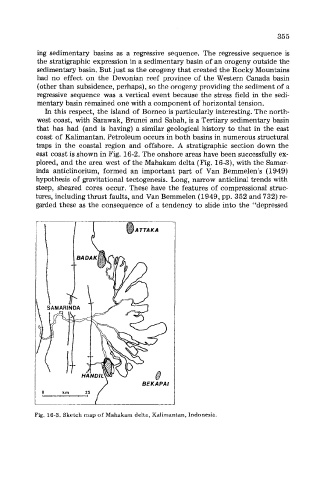
           plored, and the area west of the Mahakam delta (Fig. 16-3), with the Samar-
           inda  anticlinorium,  formed  an  important  part  of  Van  Bemmelen’s (1949)
           hypothesis of  gravitational  tectogenesis.  Long, narrow anticlinal trends with
           steep, sheared  cores  occur. These have the features of  compressional struc-
           tures, including thrust faults, and Van Bemmelen (1949, pp. 352 and 732) re-
           garded these as the consequence of  a tendency  to slide into the “depressed


                                          BEKAPAI
             0     km


           Fig. 16-3. Sketch map of Mahakam delta, Kalimantan,  Indonesia.

