


Page 391 - Petroleum Geology
P. 391
358

            to the reservoirs (see p. 243). These four fields appear to be a perfect natural
            laboratory  for  the  study  of  all the problems  discussed in Chapter 11 in an
            attempt  at reconciling the geological, geochemical and hydraulic aspects of
            generation, migration and entrapment of oil and gas in these fields.
              Returning  to the  regional  geology  of  the  island  of  Borneo,  we  see that
            structures of  both Kalimantan in the east and Sabah, Brunei and Sarawak in
            the north-west, result from orogeny in the interior of Borneo, and the progress
            of this orogeny is recorded in the sedimentary basins around the island.
              That  Borneo  is  not  a  special  case  is  seen  in  south  Sumatra. The South
            Sumatra  basin  consists  of an Eocene-Miocene-Pliocene   sedimentary cycle
            (Fig.  16-4), its  history  beginning with  a  transgression  across a pre-existing
            topography  on  pre-Tertiary  metamorphic  and  igneous  rocks  (Wennekers,
            1958; Adiwidjaja and De Coster, 1974; De Coster, 1975). The transgression
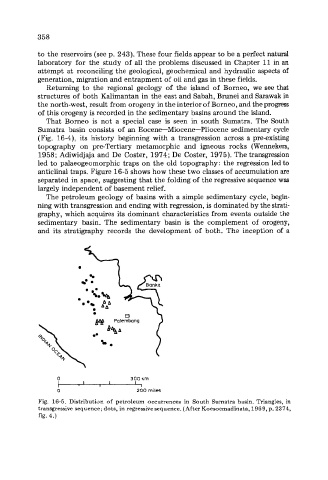
            led to palaeogeomorphic  traps on the old topography:  the regression led to
            anticlinal traps. Figure 16-5 shows how these two classes of accumulation are
            separated in space, suggesting that the folding of  the regressive sequence was
            largely independent of basement relief.
              The petroleum  geology of  basins with  a simple sedimentary cycle, begin-
            ning with transgression and ending with regression, is dominated by the strati-
            graphy, which acquires its dominant characteristics from events outside the
            sedimentary  basin.  The  sedimentary  basin  is  the  complement  of  orogeny,
            and  its  stratigraphy  records  the  development  of  both.  The  inception  of  a


                  -


                 0                    300 km
                 0                      200 miles
            Fig.  16-5. Distribution  of  petroleum  occurrences  in  South Sumatra basin.  Triangles, in
            transgressive sequence; dots, in regressive sequence. (After Koesoemadinata, 1969, p. 2374,
            fig. 4.)

