


Page 393 - Petroleum Geology
P. 393
360

              In  regressive sequences, primary  migration  is vertical to the nearest land,
            then lateral towards the land of  the time from which the regression comes.
            In a general sense, the source rocks tend to be below the massive sands; but
            here  too  the relationship is diachronous and the source rock is coeval with
            reservoir rock.  Fluctuations of  environment lead to the alternating sequence.
            Episodic transgressions and regressions within the dominant regression seem
            to  favour  the  mudstone  overlying the sandstone as the  petroleum  source
            rock  because the more rapid accumulation of sediment favours the preserva-
            tion of the organic matter. In detail, therefcre, there will be important down-
            ward  primary  migration  to  the  sandstone  carrier  beds,  followed by lateral
            secondary  migration  to traps that formed concurrently with  the accumula-
            tion of sediment.
              The  quality  of  the  crude  oil  depends  largely  on  the  stratigraphy in the
            sense that it depends on the facies of  the source rock and the conditions to
            which it was subjected during migration. The physical controls on migration
            are also related to the stratigraphy, so that petroleum normally accumulates
            in  reservoirs  that  are  stratigraphically  close  to their  source  rocks.  Passage
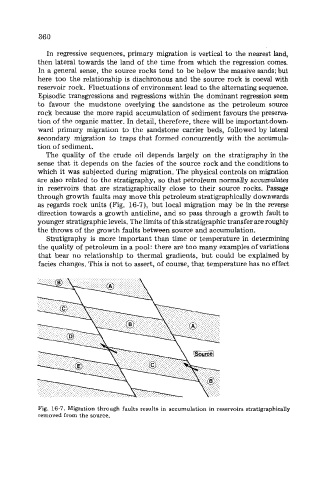
            through growth  faults may move this petroleum stratigraphically downwards
            as regards rock units  (Fig.  16-7), but local migration  may be in the reverse
            direction towards  a growth anticline, and so pass through a growth fault to
            younger stratigraphic levels. The limits of this stratigraphic transfer are roughly
            the throws of the growth faults between source and accumulation.
              Stratigraphy  is  more important than time or temperature in determining
            the quality of petroleum in a pool: there are too many examples of variations
            that  bear  no relationship  to thermal  gradients, but  could  be explained by
            facies changes. This is not to assert, of course, that temperature has no effect


            Fig.  16-7. Migration through  faults results  in accumulation in reservoirs stratigraphically
            removed from the source.

