


Page 392 - Petroleum Geology
P. 392
359

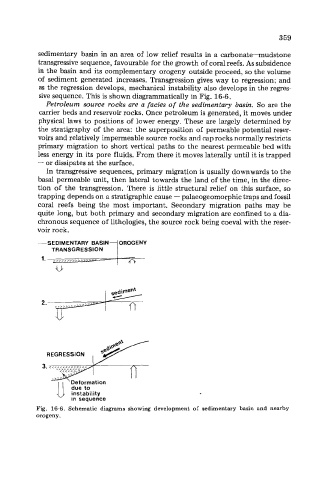
            sedimentary  basin in an area of low relief results in  a carbonate-mudstone
            transgressive sequence, favourable for the growth of coral reefs. As subsidence
            in the basin and its complementary  orogeny outside proceed, so the volume
            of  sediment  generated  increases. Transgression gives way  to regression; and
            as the regression develops, mechanical instability also develops in the regres-
            sive sequence. This is shown diagrammatically in Fig. 16-6.
              Petroleum  source  rocks are a facies  of  the sedimentary  basin.  So are the
            carrier beds and reservoir rocks. Once petroleum is generated, it moves under
            physical laws to positions of  lower energy. These are largely determined by
            the stratigraphy  of  the area:  the superposition  of  permeable potential reser-
            voirs and relatively impermeable source rocks and cap rocks normally restricts
            primary  migration  to short vertical paths to the nearest permeable bed with
            less energy in its pore fluids. From there it moves laterally until it is trapped
            - or dissipates at the surface.
              In transgressive sequences, primary migration is usually downwards to the
            basal permeable unit, then lateral towards the land of the time, in the direc-
            tion  of  the  transgression.  There  is little structural relief  on this surface, so
            trapping depends on a stratigraphic cause - palaeogeomorphic traps and fossil
            coral  reefs  being  the  most  important.  Secondary  migration  paths  may  be
            quite long, but both primary  and secondary migration are confined to a dia-
            chronous sequence of lithologies, the source rock being coeval with the reser-
            voir rock.
             1. 2
            -SEDIMENTARY   BASIN   OROGENY
                TRANSGRESSION
                >>>>>>>>>>>
                 u


                    ‘Deformation
                      due to
                      instability
                 -u.  in sequence
            Fig.  16-6. Schematic  diagrams  showing  development  of  sedimentary  basin  and  nearby
            orogeny.

