


Page 236 - Photonics Essentials an introduction with experiments
P. 236
Measurements in Photonics

          230   Characterizing Photonic Devices in the Laboratory


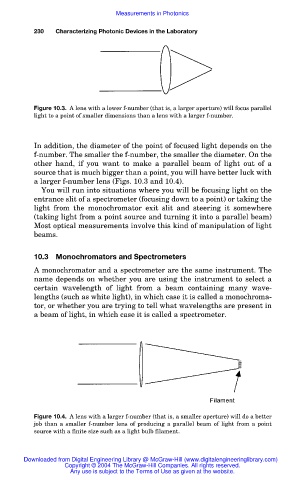
          Figure 10.3. A lens with a lower f-number (that is, a larger aperture) will focus parallel
          light to a point of smaller dimensions than a lens with a larger f-number.


          In addition, the diameter of the point of focused light depends on the
          f-number. The smaller the f-number, the smaller the diameter. On the
          other hand, if you want to make a parallel beam of light out of a
          source that is much bigger than a point, you will have better luck with
          a larger f-number lens (Figs. 10.3 and 10.4).
            You will run into situations where you will be focusing light on the
          entrance slit of a spectrometer (focusing down to a point) or taking the
          light from the monochromator exit slit and steering it somewhere
          (taking light from a point source and turning it into a parallel beam)
          Most optical measurements involve this kind of manipulation of light
          beams.


          10.3  Monochromators and Spectrometers
          A monochromator and a spectrometer are the same instrument. The
          name depends on whether you are using the instrument to select a
          certain wavelength of light from a beam containing many wave-
          lengths (such as white light), in which case it is called a monochroma-
          tor, or whether you are trying to tell what wavelengths are present in
          a beam of light, in which case it is called a spectrometer.


          Figure 10.4. A lens with a larger f-number (that is, a smaller aperture) will do a better
          job than a smaller f-number lens of producing a parallel beam of light from a point
          source with a finite size such as a light bulb filament.


       Downloaded from Digital Engineering Library @ McGraw-Hill (www.digitalengineeringlibrary.com)
                   Copyright © 2004 The McGraw-Hill Companies. All rights reserved.
                    Any use is subject to the Terms of Use as given at the website.

