


Page 132 - Photoreactive Organic Thin Films
P. 132
4, PHOTOISOMERIZATION AND PHOTO-ORIENTATION OF AZO DYE IN FILMS OF POLYMER  II I


                                         (CH 2) 5
                                           ^OCzH^*"*'1*\.
                                                OH 0  CD  OH OH
                               SiOo Substrate


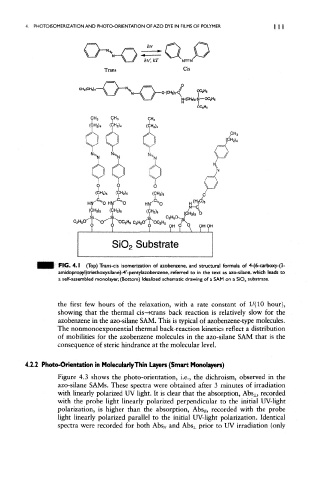
               FK3. 4.1 (Top) Trans-cis isomerization of azobenzene, and structural formula of 4-(6-carboxy-(3-
               amidapropyl)triethoxysilane)-4'-pentyfazobenzene, referred to in the text as azo-silane, which leads to
               a self-assembled monolayer, (Bottom) Idealized schematic drawing of a SAM on a SiO x substrate.


               the first few hours of the relaxation, with a rate constant of 1/(10 hour),
               showing that the thermal cis-Hrans back reaction is relatively slow for the
               azobenzene in the azo-silane SAM. This is typical of azobenzene-type molecules.
               The nonmonoexponential thermal back-reaction kinetics reflect a distribution
               of mobilities for the azobenzene molecules in the azo-silane SAM that is the
               consequence of steric hindrance at the molecular level.


      4.2.2 Photo-Orientation in Molecularly Thin Layers (Smart Monolayers)
               Figure 4.3 shows the photo-orientation, i.e., the dichroism, observed in the
               azo-silane SAMs. These spectra were obtained after 3 minutes of irradiation
               with linearly polarized UV light. It is clear that the absorption, Abs 1} recorded
               with the probe light linearly polarized perpendicular to the initial UV-light
               polarization, is higher than the absorption, Abs//, recorded with the probe
               light linearly polarized parallel to the initial UV-light polarization. Identical
               spectra were recorded for both Abs// and Abs x prior to UV irradiation (only

