


Page 137 - Photoreactive Organic Thin Films
P. 137
116                                              ZOUHEIR SEKKAT AND WOLFGANG KNOLL


                         0.0
                           35.0  37.5  40.0   42.5  45.0  47.5   50.0  52.5  55.0
                                              External Angle (Degrees)
                        0.460
                                            .Blue On         I Blue On  Blue On


                        0.455 -                  Blue


                        0.450-


                        0.445-  IJVOn                              UVOn


                                                       UV              UVOff
                        0.440-
                                    240     480     720     960     1200   1440
                                                  Time, t / sec
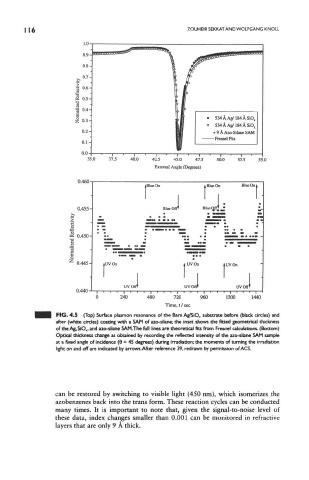
                 FIG. 4.5  (Top) Surface plasmon resonance of the Bare Ag/SiO x substrate before (black circles) and
                after (white circles) coating with a SAM of azo-silane; the inset shows the fitted geometrical thickness
                of the Ag, SiO x, and azo-silane SAMThe full lines are theoretical fits from Fresnel calculations. (Bottom)
                Optical thickness change as obtained by recording the reflected intensity of the azo-silane SAM sample
                at a fixed angle of incidence (6 = 45 degrees) during irradiation; the moments of turning the irradiation
                light on and off are indicated by arrows. After reference 39, redrawn by permission of ACS.


                can be restored by switching to visible light (450 nm), which isomerizes the
                azobenzenes back into the trans form. These reaction cycles can be conducted
                many times. It is important to note that, given the signal-to-noise level of
                these data, index changes smaller than 0.001 can be monitored in refractive
                layers that are only 9 A thick.

