


Page 138 - Photoreactive Organic Thin Films
P. 138
4. PHOTOISOMERIZATION AND PHOTO-ORIENTATION OF AZO DYE IN FILMS OF POLYMER  J \J

     4.3 PHOTOISOM ERIZATION AND PHOTO-ORIENTATION OF AZOBENZEN ESI N
     SUPRAMOLECULAR ASSEMBLIES: PHOTO-CONTROL OFTHE STRUCTURAL AND
     OPTICAL PROPERTIES OF LANGMUIR-BLODGETT-KUHN MULTILAYERS OF HAIRY-
      ROD AZO-POLYGLUTAM ATES

               Hairy-rod molecules, consisting of rod-like molecules with covalently attached
                                53 56
               flexible side chains "  have been designed and used for forming nano-
               structured systems by using the LBK deposition technique. The flexible side
               chains enable the stiff molecules to be soluble in organic solvents and improve
               their transfer through LBK deposition. At the air/water interface, the side
               chains are oriented away from the water subphase, and the rods lay flat on
               the interface. For small substrates (in comparison to the width of the trough),
               the flow process during LBK deposition orients the rods parallel to the
               dipping direction, and the side chains form a liquid-like matrix for the rods in
               the reinforced liquid model. 54
                   Hairy-rod molecules containing azobenzene units in the side chains
                                                 57
               can be assembled into LBK structures.  The azobenzene molecules undergo
               trans«-K:is photoisomerization under light irradiation of appropriate wavelength
               and alter the structural properties of LBK films. We will discuss the photoinduced
               movement of the azobenzene molecule in a series of LBK structures of azo-
               polyglutamates in light of their optical and structural properties. The polymers
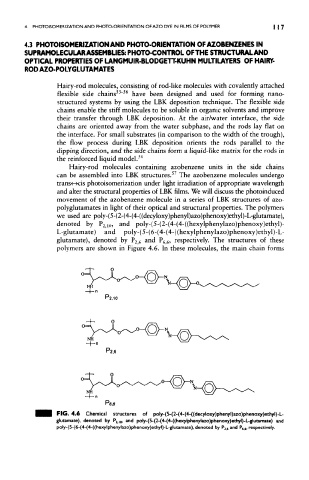
               we used are poly-(5-(2-(4-(4-((decyloxy)phenyl)azo)phenoxy)ethyl)-L-glutamate),
               denoted by P 2,Kb and poly-(5-(2-(4-(4-((hexylphenylazo)phenoxy)ethyl)-
               L-glutamate) and    poly-(5-(6-(4-(4-((hexylphenylazo)phenoxy)ethyl)-L-
               glutamate), denoted by P 2j<$ and P 6i6, respectively. The structures of these
               polymers are shown in Figure 4.6. In these molecules, the main chain forms


                             P2.10


                       •—•{-- n

               PIG. 4.6 Chemical structures of poly-(5-(2-(4-(4-((decyloxy)phenyl)azo)phenoxy)ethyl}-L-
                                    ar
               glutamate), denoted by P 2iio> »d poly-(5-(2-(4-(4-((hexylphenylazo)phenoxy)ethyl)-L-glutamate) and
               poly-(5-(6-(4-(4-((hexylphenylazo)phenoxy)ethyl)-L-glutamate), denoted by P 2 , 4 and P 6 6, respectively.

