


Page 140 - Photoreactive Organic Thin Films
P. 140
4. PHOTOISOMERIZATION AND PHOTO-ORIENTATION OF AZO DYE IN FILMS OF POLYMER  119


                                               Angle [deg]

                            1,0-

                            0,8-
                          =? 0,6-
                          01


                          0)
                          CC 0,2-
                            0.0-
                                  0        1000     2000    3000     4000
                                                Time [s]
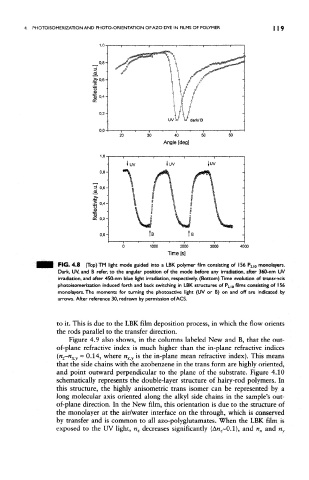
               FIG. 4.8  (Top) TM light mode guided into a LBK polymer film consisting of 156 P i(0 monolayers.
               Dark, UV, and B refer, to the angular position of the mode before any irradiation, after 36Q-nm UV
               irradiation, and after 450-nm blue light irradiation, respectively. (Bottom) Time evolution of trans<~Kis
                                                                     ms
               photoisomerization induced forth and back switching in LBK structures of P 2,io f''   consisting of 156
               monolayers. The moments for turning the photoactive light (UV or B) on and off are indicated by
               arrows. After reference 30, redrawn by permission of ACS.


               to it. This is due to the LBK film deposition process, in which the flow orients
               the rods parallel to the transfer direction.
                   Figure 4.9 also shows, in the columns labeled New and B, that the out-
               of-plane refractive index is much higher than the in-plane refractive indices
               (n z-n Xsy ~ 0.14, where n x>y is the in-plane mean refractive index). This means
               that the side chains with the azobenzene in the trans form are highly oriented,
               and point outward perpendicular to the plane of the substrate. Figure 4.10
               schematically represents the double-layer structure of hairy-rod polymers. In
               this structure, the highly anisometric trans isomer can be represented by a
               long molecular axis oriented along the alkyl side chains in the sample's out-
               of-plane direction. In the New film, this orientation is due to the structure of
               the monolayer at the air/water interface on the through, which is conserved
               by transfer and is common to all azo-polyglutamates. When the LBK film is
               exposed to the UV light, n z decreases significantly (Aw 2~0.1), and n x and n v

