


Page 145 - Photoreactive Organic Thin Films
P. 145
§24                                              ZOUHEIR SEKKAT AND WOLFGANG KNOLL


                             PI-3a


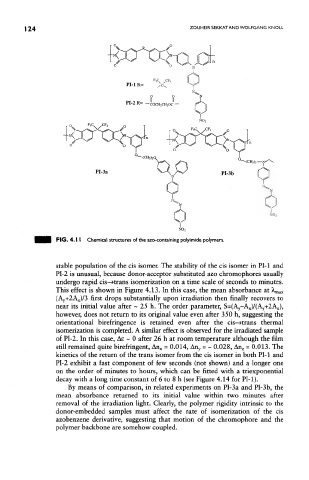
                 FIG. 4.11 Chemical structures of the azo-containing polyimide polymers.


                 stable population of the cis isomer. The stability of the cis isomer in Pl-1 and
                 PI-2 is unusual, because donor-acceptor substituted azo chromophores usually
                 undergo rapid cis—»trans isomerization on a time scale of seconds to minutes.
                 This effect is shown in Figure 4.13. In this case, the mean absorbance at 'k max
                 (A y+2A x)/3 first drops substantially upon irradiation then finally recovers to
                 near its initial value after ~ 25 h. The order parameter, S=(A y-A x)/(A y4-2A x),
                 however, does not return to its original value even after 350 h, suggesting the
                 orientational birefringence is retained even after the cis—»trans thermal
                 isomerization is completed. A similar effect is observed for the irradiated sample
                 of PI-2. In this case, AE ~ 0 after 26 h at room temperature although the film
                 still remained quite birefringent, An x = 0.014, An y = - 0.028, An z = 0.013. The
                 kinetics of the return of the trans isomer from the cis isomer in both PI-1 and
                 PI-2 exhibit a fast component of few seconds (not shown) and a longer one
                 on the order of minutes to hours, which can be fitted with a triexponential
                 decay with a long time constant of 6 to 8 h (see Figure 4.14 for PI-1).
                     By means of comparison, in related experiments on PI-3a and PI-3b, the
                 mean absorbance returned to its initial value within two minutes after
                 removal of the irradiation light. Clearly, the polymer rigidity intrinsic to the
                 donor-embedded samples must affect the rate of isomerization of the cis
                 azobenzene derivative, suggesting that motion of the chromophore and the
                 polymer backbone are somehow coupled.

