


Page 146 - Photoreactive Organic Thin Films
P. 146
4. PHOTOISOMERIZATION AND PHOTO-ORIENTATION OF AZO DYE IN FILMS OF POLYMER  25


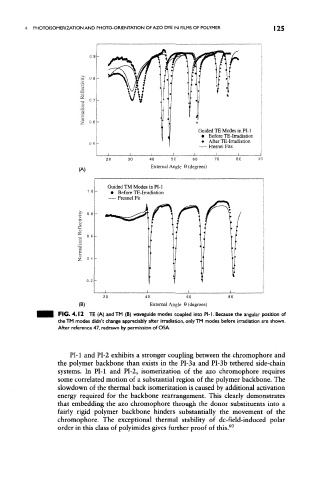
                                                         Guided TE Modes in PI-1
                                                          • Before TE-Irradiation
                                                          » After TE-Irradiation
                                                         — Fresnel Fits
                                                              I      i    .
                                          40     50    60     70
                                           External Angle 6 (degrees)
                      (A)

                              Guided TM Modes in PI-1
                               • Before TE-Irradiation
                                 Fresnel Fit


                                         40          60
                      (B)                  External Angle 9 (degrees)
                FIG. 4.12 TE (A) and TM (B) waveguide modes coupled into PI-1. Because the angular position of
               the TM modes didn't change appreciably after irradiation, only TM modes before irradiation are shown.
                After reference 47, redrawn by permission of OSA.


                   PI-1 and PI-2 exhibits a stronger coupling between the chromophore and
               the polymer backbone than exists in the PI-3a and PI-3b tethered side-chain
               systems. In PI-1 and PI-2, isomerization of the azo chromophore requires
               some correlated motion of a substantial region of the polymer backbone. The
               slowdown of the thermal back isomerization is caused by additional activation
               energy required for the backbone rearrangement. This clearly demonstrates
               that embedding the azo chromophore through the donor substituents into a
               fairly rigid polymer backbone hinders substantially the movement of the
               chromophore. The exceptional thermal stability of dc-field-induced polar
               order in this class of polyimides gives further proof of this. 60

