


Page 150 - Photoreactive Organic Thin Films
P. 150
4. PHOTOlSOMEmZATION AND PHOTO-ORIENTATION OF AZO DYE IN FILMS OF POLYMER  129


                                            400   500   600   700   800
                                              Wavelength (nm)
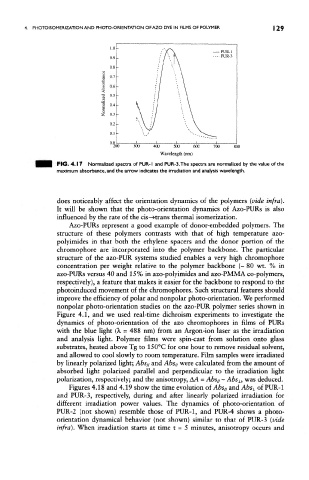
                FIG. 4,17 Normalized spectra of PUR-1 and PUR-3.The spectra are normalized by the value of the
                maximum absorbance, and the arrow indicates the irradiation and analysis wavelength.


                does noticeably affect the orientation dynamics of the polymers (vide infra}.
                It will be shown that the photo-orientation dynamics of Azo-PURs is also
                influenced by the rate of the cis—>trans thermal isomerization.
                   Azo-PURs represent a good example of donor-embedded polymers. The
                structure of these polymers contrasts with that of high temperature azo-
                polyimides in that both the ethylene spacers and the donor portion of the
                chromophore are incorporated into the polymer backbone. The particular
                structure of the azo-PUR systems studied enables a very high chromophore
                concentration per weight relative to the polymer backbone (~ 80 wt. % in
                azo-PURs versus 40 and 15% in azo-polyimides and azo-PMMA co-polymers,
                respectively), a feature that makes it easier for the backbone to respond to the
                photoinduced movement of the chromophores. Such structural features should
                improve the efficiency of polar and nonpolar photo-orientation. We performed
                nonpolar photo-orientation studies on the azo-PUR polymer series shown in
                Figure 4.1, and we used real-time dichroism experiments to investigate the
                dynamics of photo-orientation of the azo chromophores in films of PURs
                with the blue light (K = 488 nm) from an Argon-ion laser as the irradiation
                and analysis light. Polymer films were spin-cast from solution onto glass
                substrates, heated above Tg to 150°C for one hour to remove residual solvent,
                and allowed to cool slowly to room temperature. Film samples were irradiated
                by linearly polarized light; Abs// and Abs ft were calculated from the amount of
                absorbed light polarized parallel and perpendicular to the irradiation light
               polarization, respectively; and the anisotropy, AA = Abs/ f ~ Abs±, was deduced.
                   Figures 4.18 and 4.19 show the time evolution of Abs// and Abs ± of PUR-1
                and PUR-3, respectively, during and after linearly polarized irradiation for
                different irradiation power values. The dynamics of photo-orientation of
                PUR-2 (not shown) resemble those of PUR-1, and PUR-4 shows a photo-
                orientation dynamical behavior (not shown) similar to that of PUR-3 (vide
                infra). When irradiation starts at time t = 5 minutes, anisotropy occurs and

