


Page 153 - Photoreactive Organic Thin Films
P. 153
J 3 2                                            ZOUHEIR SEKKAT AND WOLFGANG KNOLL

                 the rate of cis-^trans thermal isomerization is quite high, a feature that shows
                 that the azo-chromophore is in the trans form most of the time during
                 trans«-»cis cycling. The near-pure photo-orientation observed in PUR-1 is in
                 clear contrast to photo-orientation observations in all of the azo-poiymers
                 studied to date, including PUR-2, PUR-3, and PUR-4, wherein both 'Abs/ f and
                 Abs ± change in the same direction upon photo-orientation (OHB), as shown
                 in Figure 4.19 for PUR-3, and Abs± can exceed Ab$ 0 only for weak pump
                 intensities to minimize the concentration, of the cis population. Indeed, weak
                 pump intensities minimize the cis concentration, thereby favoring orientational
                 redistribution over OHB.
                     Near-pure photo-orientation occurs in PUR-1 and not in PUR-2, PUR-3
                 and PUR-4 because of a fast cis->trans isomerization of PUR-1 versus PUR-3
                 and PUR-4 and a seemingly small difference into the polymer backbone of
                 PUR-1 versus PUR-2. Although PUR-1 and PUR-3 have the same polymer
                 backbone, the CN electron-withdrawing group of the azo chromophore in
                 PUR-3 and PUR-4 slows the cis-»trans thermal isomerization. The isotropic
                 absorbance of PUR-1 is recovered more quickly than that of PUR-3 upon
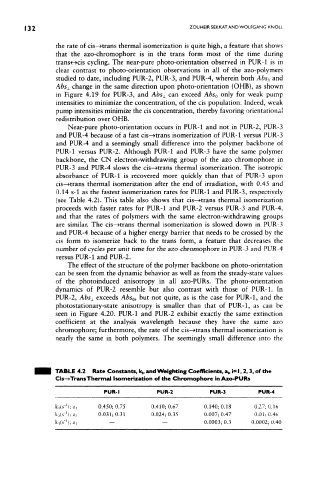
                 cis-»trans thermal isomerization after the end of irradiation, with 0.45 and
                 0.14 s-1 as the fastest isomerization rates for PUR-1 and PUR-3, respectively
                 (see Table 4.2). This table also shows that cis-~»trans thermal isomerization
                 proceeds with faster rates for PUR-1 and PUR-2 versus PUR-3 and PUR-4,
                 and that the rates of polymers with the same electron-withdrawing groups
                 are similar. The cis—Hrans thermal isomerization is slowed down in PUR-3
                 and PUR-4 because of a higher energy barrier that needs to be crossed by the
                 cis form to isomerize back to the trans form, a feature that decreases the
                 number of cycles per unit time for the azo-chromophore in PUR-3 and PUR-4
                 versus PUR-1 and PUR-2.
                     The effect of the structure of the polymer backbone on photo-orientation
                 can be seen from the dynamic behavior as well as from the steady-state values
                 of the photoinduced anisotropy in all azo-PURs. The photo-orientation
                 dynamics of PUR-2 resemble but also contrast with those of PUR-1. In
                 PUR-2, Abs ± exceeds Abs 0, but not quite, as is the case for PUR-1, and the
                 photostationary-state anisotropy is smaller than that of PUR-1, as can be
                 seen in Figure 4.20. PUR-1 and PUR-2 exhibit exactly the same extinction
                 coefficient at the analysis wavelength because they have the same azo
                 chromophore; furthermore, the rate of the cis—»trans thermal isomerization is
                 nearly the same in both polymers. The seemingly small difference into the


                 TABLE 4.2 Rate Constants, k,, and Weighting Coefficients, a,, i= 1,2,3, of the
                 Cis-VTrans Thermal Isomerization of the Chromophore in Azo-PURs

                               PUR-1           PUR-2           PUR-3         PUR-4
                    1
                  •i(s- ); a,  0.450; 0.75   0.410; 0.67     0.140; 0.18    0.27; 0.16
                    -1        0.031; 0.31    0.024; 0.35     0.007; 0.47    0.01; 0.46
                  •2(s ); a 2
                                 __              _
                    1                                        0.0003; 0.3   0.0002; 0.40
                  ^(s" ); a 3

