


Page 156 - Photoreactive Organic Thin Films
P. 156
4, PHOTOiSOMERIZATION AND PHOTO-ORIENTATION OF AZO DYE IN FILMS OF POLYMER  | J 5

                                                         63
               activation and reaction volumes in solution.  For photo and thermal
               isomerization reactions, kinetics of both ground- and excited-state isomerization
               are used to assess solvent and high-viscosity solution effects on isomerization
                                              64 66
               rates and isomerization movement. "  Regarding the effects of pressure on
               photoisomerization and photo-orientation in polymeric thin films, we show
               that both photoisomerization and photo-orientation of disperse red one (DR1),
               an azo dye, flexibly tethered to a poly(methyl-methacrylate) (PMMA) polymer,
               referred to in the text as PMMA-DRl, are hindered by the application of
                                 48
               hydrostatic pressure.
                   We used ATR prism coupling as well as a Kerr gate optical setup to probe
               the influence of pressure on photoisomerization and photo-orientation in
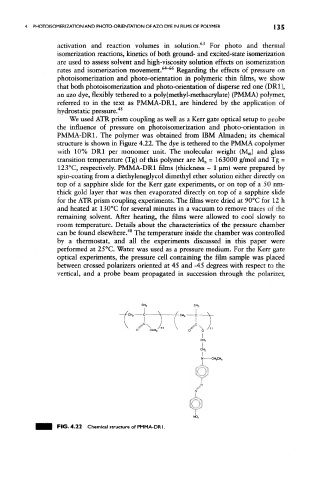
               PMMA-DRl. The polymer was obtained from IBM Almaden; its chemical
               structure is shown in Figure 4.22. The dye is tethered to the PMMA copolymer
               with 10% DR1 per monomer unit. The molecular weight (M m) and glass
               transition temperature (Tg) of this polymer are M n = 163000 g/mol and Tg =
               123°C, respectively. PMMA-DRl films (thickness ~ 1 pm) were prepared by
               spin-coating from a diethyleneglycol dimethyl ether solution either directly on
               top of a sapphire slide for the Kerr gate experiments, or on top of a 50 nm~
               thick gold layer that was then evaporated directly on top of a sapphire slide
               for the ATR prism coupling experiments. The films were dried at 90°C for 12 h
               and heated at 130°C for several minutes in a vacuum to remove traces of the
               remaining solvent. After heating, the films were allowed to cool slowly to
               room temperature. Details about the characteristics of the pressure chamber
                                    48
               can be found elsewhere.  The temperature inside the chamber was controlled
               by a thermostat, and all the experiments discussed in this paper were
               performed at 25°C. Water was used as a pressure medium. For the Kerr gate
               optical experiments, the pressure cell containing the film sample was placed
               between crossed polarizers oriented at 45 and -45 degrees with respect to the
               vertical, and a probe beam propagated in succession through the polarizer,


               FIG. 4.22  Chemical structure of PMMA-DRI.

