


Page 158 - Photoreactive Organic Thin Films
P. 158
4, PHOT01SOMERIZATION AND PHOTO-ORIENTATION OF AZO DYE IN FILMS OF POLYMER  37


                                                -Pump Off       (l)p= IMPa
                                                                (2)p= 30MPa
                                                                (3)p= 60MPa
                         0.10
                                                                (4)p= 90MPa
                                                         Erasure (5)P=l20MPa
                      3  0.08                                   (6)p=15QMPa
                      03
                      .0  0.06


                         0.04
                         0.02


                                   Pump On


                                              Time t / minutes
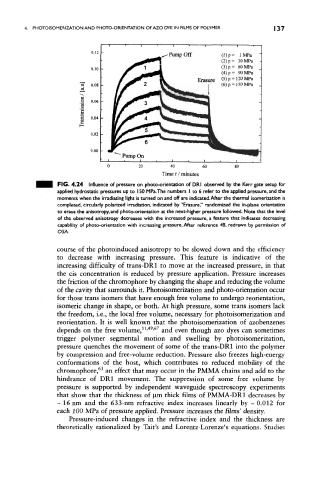
                FIG. 4.24  Influence of pressure on photo-orientation of DRI observed by the Kerr gate setup for
                applied hydrostatic pressures up to 150 MPa.The numbers I to 6 refer to the applied pressure, and the
                moments when the irradiating light is turned on and off are indicated.After the thermal isomenzation is
                completed, circularly polarized irradiation, indicated by "Erasure," randomized the in-plane orientation
                to erase the anisotropy, and photo-orientation at the next-higher pressure followed. Note that the level
                of the observed anisotropy decreases with the increased pressure, a feature that indicates decreasing
                capability of photo-orientation with increasing pressure. After reference 48, redrawn by permission of
                OSA.

                course of the photoinduced anisotropy to be slowed down and the efficiency
                to decrease with increasing pressure. This feature is indicative of the
                increasing difficulty of trans-DRl to move at the increased pressure, in that
                the cis concentration is reduced by pressure application. Pressure increases
                the friction of the chromophore by changing the shape and reducing the volume
                of the cavity that surrounds it. Photoisomerization and photo-orientation occur
                for those trans isomers that have enough free volume to undergo reorientation,
                isorneric change in shape, or both. At high pressure, some trans isomers lack
                the freedom, i.e., the local free volume, necessary for photoisomerization and
                reorientation. It is well known that the photoisomerization of azobenzenes
                                         11 49 67
                depends on the free volume, ' '  and even though azo dyes can sometimes
                trigger polymer segmental motion and swelling by photoisomerization,
                pressure quenches the movement of some of the trans-DRl into the polymer
                by compression and free-volume reduction. Pressure also freezes high-energy
                conformations of the host, which contributes to reduced mobility of the
                            63
                chromophore,  an effect that may occur in the PMMA chains and add to the
                hindrance of DRI movement. The suppression of some free volume by
                pressure is supported by independent waveguide spectroscopy experiments
                that show that the thickness of fim thick films of PMMA-DR1 decreases by
                -16 nm and the 633-nm refractive index increases linearly by - 0.012 for
                each 100 MPa of pressure applied. Pressure increases the films' density.
                   Pressure-induced changes in the refractive index and the thickness are
                theoretically rationalized by Tait's and Lorentz-Lorenze's equations. Studies

