


Page 155 - Photoreactive Organic Thin Films
P. 155
134                                              ZOUHEIR SEKKAT AND WOLFGANG KNOLL

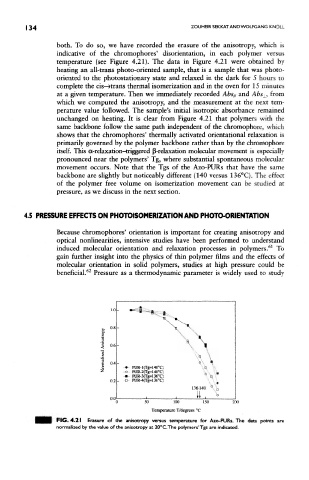
                 both. To do so, we have recorded the erasure of the anisotropy, which is
                 indicative of the chromophores' disorientation, in each polymer versus
                 temperature (see Figure 4.21). The data in Figure 4.21 were obtained by
                 heating an all-trans photo-oriented sample, that is a sample that was photo-
                 oriented to the photostationary state and relaxed in the dark for 5 hours to
                 complete the cis—»trans thermal isomerization and in the oven for 15 minutes
                 at a given temperature. Then we immediately recorded Abs// and Abs±, from
                 which we computed the anisotropy, and the measurement at the next tem-
                 perature value followed. The sample's initial isotropic absorbance remained
                 unchanged on heating. It is clear from Figure 4.21 that polymers with the
                 same backbone follow the same path independent of the chromophore, which
                 shows that the chromophores' thermally activated orientational relaxation is
                 primarily governed by the polymer backbone rather than by the chromophore
                 itself. This a-relaxation-triggered {^-relaxation molecular movement is especially
                 pronounced near the polymers' Tg, where substantial spontaneous molecular
                 movement occurs. Note that the Tgs of the Azo-PURs that have the same
                 backbone are slightly but noticeably different (140 versus 136°C). The effect
                 of the polymer free volume on isomerization movement can be studied at
                 pressure, as we discuss in the next section.


       4.5 PRESSURE EFFECTS ON PHOTOISOMERIZATION AND PHOTO-ORIENTATION

                 Because chromophores' orientation is important for creating anisotropy and
                 optical nonlinearities, intensive studies have been performed to understand
                                                                               61
                 induced molecular orientation and relaxation processes in polymers.  To
                 gain further insight into the physics of thin polymer films and the effects of
                 molecular orientation in solid polymers, studies at high pressure could be
                          62
                 beneficial.  Pressure as a thermodynamic parameter is widely used to study


                                 1.0

                                 0.8


                                     • PUR-l(Tg=140°C)
                                     o PUR-2(Tg=140°C)
                                     -•-• PUR-3{Tg=136°C)
                                 0.2  -D- PUR-4(Tg=136°C)
                                                         136140
                                                          II ,
                                 0.0
                                           50      100      150      200
                                             Temperature I/degrees °C
                 FIG. 4.21 Erasure of the anisotropy versus temperature for Azo-PURs. The data points are
                 normalized by the value of the anisotropy at 20°C.The polymers' Tgs are indicated.

