


Page 154 - Photoreactive Organic Thin Films
P. 154
4. PHOTOISOMERIZATiON AND PHOTO-ORIENTATION OF AZO DYE IN FILMS OF POLYMER  133

               polymer backbone, i.e., the presence of the aromatic ring into the backbone
               of PUR-1, clearly influences the photo-orientation dynamics and efficiency
               for PUR-1 versus PUR-2. This influence of the polymer backbone was also
               observed for PUR-3 versus PUR-4, confirming the influence of polymer
               structural effects on photo-orientation.
                   The levels of photo-induced anisotropy in all four Azo-PURs are also
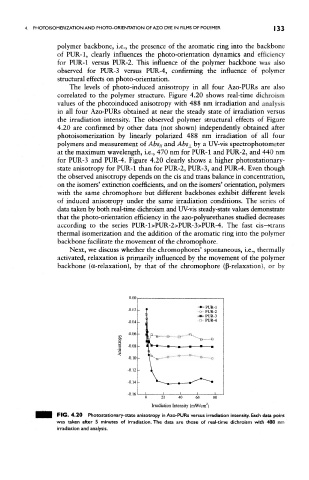
               correlated to the polymer structure. Figure 4.20 shows real-time dichroism
               values of the photoinduced anisotropy with 488 nm irradiation and analysis
               in all four Azo-PURs obtained at near the steady state of irradiation versus
               the irradiation intensity. The observed polymer structural effects of Figure
               4.20 are confirmed by other data (not shown) independently obtained after
               photoisomerization by linearly polarized 488 nm irradiation of all four
               polymers and measurement of Abs// and Abs± by a UV-vis spectrophotometer
               at the maximum wavelength, i.e., 470 nm for PUR-1 and PUR-2, and 440 nm
               for PUR-3 and PUR-4. Figure 4.20 clearly shows a higher photostationary-
               state anisotropy for PUR-1 than for PUR-2, PUR-3, and PUR-4. Even though
               the observed anisotropy depends on the cis and trans balance in concentration,
               on the isomers' extinction coefficients, and on the isomers' orientation, polymers
               with the same chromophore but different backbones exhibit different levels
               of induced anisotropy under the same irradiation conditions. The series of
               data taken by both real-time dichroism and UV-vis steady-state values demonstrate
               that the photo-orientation efficiency in the azo-polyurethanes studied decreases
               according to the series PUR-1 >PUR-2>PUR-3>PUR-4. The fast cis-»trans
               thermal isomerization and the addition of the aromatic ring into the polymer
               backbone facilitate the movement of the chromophore.
                   Next, we discuss whether the chromophores' spontaneous, i.e., thermally
               activated, relaxation is primarily influenced by the movement of the polymer
               backbone (a-relaxation), by that of the chromophore (^-relaxation}, or by


                                    0.00
                                                         -•-PUR-1
                                    -0.02
                                                         •-0- PUR-2
                                                         -*- PUR-3
                                    -0.04                -O- PUR-4
                                    -0.06

                                    -0.08
                                    -0.10
                                    -0.12
                                    -0.14
                                    -0.16
                                         0    20   40   60   80
                                           Irradiation Intensity (mW/cm ) 2
               FIG. 4.20  Photostationary-state anisotropy in Azo-PURs versus irradiation intensity. Each data point
               was taken after 5 minutes of irradiation. The data are those of real-time dichroism with 488 nm
               irradiation and analysis.

