


Page 157 - Photoreactive Organic Thin Films
P. 157
936                                              ZOUHEIR SEKKAT AND WOLFGANG KNOLL

                           0.75
                                    on                                 on
                           0.70

                           0.65

                           0.60
                                                            5
                      )                               p=1000-10  Pa @ 0=54.27°
                     0)    0.55                            s
                     4=                            _ T_  p= 760-10  Pa @ 0=53.96°
                     CD
                                                           5
                                                      p= 520-10  Pa <g ©=53.65°
                                                            5
                           0.50                    -*- p= 260-10  Pa @ 0*53.35°
                                                           5
                                                   _._p= 40-10 Pa@e=53.05°
                          0.45
                                              Off
                                     100     200     300     400     500     600
                                                    t/sec
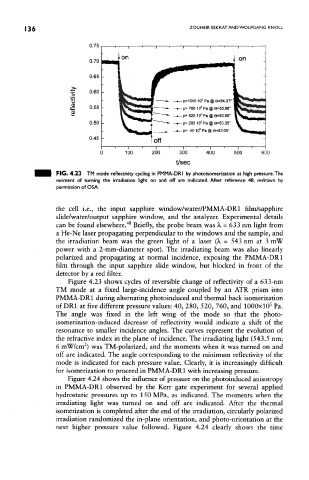
                 FIG. 4.23 TM mode reflectivity cycling in PMMA-DRI by photoisomerization at high pressure. The
                 moment of turning the irradiation light on and off are indicated. After reference 48, redrawn by
                 permission of OSA.

                 the cell i.e., the input sapphire window/water/PMMA-DRl film/sapphire
                 slide/water/output sapphire window, and the analyzer. Experimental details
                                     48
                 can be found elsewhere.  Briefly, the probe beam was A, = 633 nm light from
                 a He-Ne laser propagating perpendicular to the windows and the sample, and
                 the irradiation beam was the green light of a laser (X = 543 nm at 3 mW
                power with a 2-mm-diameter spot). The irradiating beam was also linearly
                polarized and propagating at normal incidence, exposing the PMMA-DRI
                 film through the input sapphire slide window, but blocked in front of the
                 detector by a red filter.
                    Figure 4.23 shows cycles of reversible change of reflectivity of a 633-nm
                TM mode at a fixed large-incidence angle coupled by an ATR prism into
                 PMMA-DRI during alternating photoinduced and thermal back isomerization
                                                                                  5
                 of DR1 at five different pressure values: 40, 280, 520, 760, and lOOOxlO  Pa.
                The angle was fixed in the left wing of the mode so that the photo-
                isomerization-induced decrease of reflectivity would indicate a shift of the
                resonance to smaller incidence angles. The curves represent the evolution of
                the refractive index in the plane of incidence. The irradiating light (543.5 nm;
                         2
                 6 mW/crn ) was TM-polarized, and the moments when it was turned on and
                off are indicated. The angle corresponding to the minimum reflectivity of the
                mode is indicated for each pressure value. Clearly, it is increasingly difficult
                for isomerization to proceed in PMMA-DRI with increasing pressure.
                    Figure 4.24 shows the influence of pressure on the photoinduced anisotropy
                in PMMA-DRI observed by the Kerr gate experiment for several applied
                hydrostatic pressures up to 150 MPa, as indicated. The moments when the
                irradiating light was turned on and off are indicated. After the thermal
                isomerization is completed after the end of the irradiation, circularly polarized
                irradiation randomized the in-plane orientation, and photo-orientation at the
                next higher pressure value followed. Figure 4.24 clearly shows the time

