


Page 149 - Photoreactive Organic Thin Films
P. 149
128                                              ZOUHEIR SEKKAT AND WOLFGANG KNOLL

                 photoisomerization-induced molecular movement depends strongly on the
                 molecular structure of the unit building blocks of the polymer, a feature
                 confirmed in azo-polyurethanes.


        4.4.2 Photoisomerization and Photo-Orientation of Flexible Azo-Polyurethanes
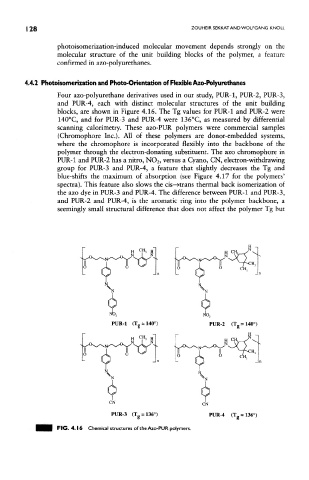
                 Four azo-polyurethane derivatives used in our study, PUR-1, PUR-2, PUR-3,
                 and PUR-4, each with distinct molecular structures of the unit building
                 blocks, are shown in Figure 4.16. The Tg values for PUR-1 and PUR-2 were
                  140°C, and for PUR-3 and PUR-4 were 136°C, as measured by differential
                 scanning calorimetry. These azo-PUR polymers were commercial samples
                 (Chromophore Inc.). All of these polymers are donor-embedded systems,
                 where the chromophore is incorporated flexibly into the backbone of the
                 polymer through the electron-donating substituent. The azo chromophore in
                 PUR-1 and PUR-2 has a nitro, NO 2, versus a Cyano, CN, electron-withdrawing
                 group for PUR-3 and PUR-4, a feature that slightly decreases the Tg and
                 blue-shifts the maximum of absorption (see Figure 4.17 for the polymers'
                 spectra). This feature also slows the cis—Hrans thermal back isomerization of
                 the azo dye in PUR-3 and PUR-4. The difference between PUR-1 and PUR-3,
                 and PUR-2 and PUR-4, is the aromatic ring into the polymer backbone, a
                 seemingly small structural difference that does not affect the polymer Tg but


                                 PUR-1 (T g = 140°)           PUR-2 (T g = 140°)


                                 CN
                                 PUR-3 (T g = 136°)           PUR-4 (T g = 136°)

                 FIG. 4.16 Chemical structures of the Azo-PUR polymers.

