


Page 148 - Photoreactive Organic Thin Films
P. 148
4, PHOTOISOMERIZATION AND PHOTO-ORIENTATION OF AZO DYE IN FILMS OF POLYMER  j 2 7


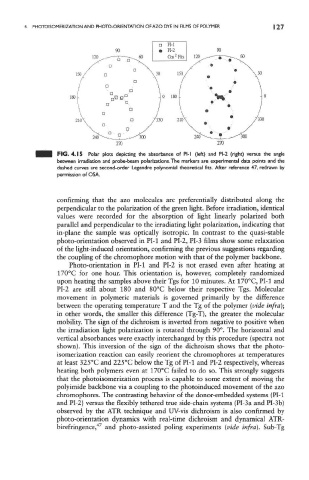
               FIG. 4.15 Polar plots depicting the absorbance of PI-1 (left) and PI-2 (right) versus the angle
               between irradiation and probe-beam polarizations. The markers are experimental data points and the
               dashed curves are second-order Legendre polynomial theoretical fits. After reference 47, redrawn by
               permission of OSA.


               confirming that the azo molecules are preferentially distributed along the
               perpendicular to the polarization of the green light. Before irradiation, identical
               values were recorded for the absorption of light linearly polarized both
               parallel and perpendicular to the irradiating light polarization, indicating that
               in-plane the sample was optically isotropic. In contrast to the quasi-stable
               photo-orientation observed in PI-1 and PI-2, PI-3 films show some relaxation
               of the light-induced orientation, confirming the previous suggestions regarding
               the coupling of the chromophore motion with that of the polymer backbone.
                   Photo-orientation in PI-1 and PI-2 is not erased even after heating at
                170°C for one hour. This orientation is, however, completely randomized
               upon heating the samples above their Tgs for 10 minutes. At 170°C, PI-1 and
               PI-2 are still about 180 and 80°C below their respective Tgs. Molecular
               movement in polymeric materials is governed primarily by the difference
               between the operating temperature T and the Tg of the polymer (vide infra);
               in other words, the smaller this difference (Tg-T), the greater the molecular
               mobility. The sign of the dichroism is inverted from negative to positive when
               the irradiation light polarization is rotated through 90°. The horizontal and
               vertical absorbances were exactly interchanged by this procedure (spectra not
               shown). This inversion of the sign of the dichroism shows that the photo-
               isomerization reaction can easily reorient the chromophores at temperatures
               at least 325°C and 225°C below the Tg of PI-1 and PI-2 respectively, whereas
               heating both polymers even at 170°C failed to do so. This strongly suggests
               that the photoisomerization process is capable to some extent of moving the
               polyimide backbone via a coupling to the photoinduced movement of the azo
               chromophores. The contrasting behavior of the donor-embedded systems (PI-1
               and PI-2) versus the flexibly tethered true side-chain systems (PI-3a and PI-3b)
               observed by the ATR technique and UV-vis dichroism is also confirmed by
               photo-orientation dynamics with real-time dichroism and dynamical ATR-
                           47
               birefringence,  and photo-assisted poling experiments (vide infra). Sub-Tg

