


Page 142 - Photoreactive Organic Thin Films
P. 142
4. PHOTOISOMERIZATION AND PHOTO-ORIENTATION OF AZO DYE IN FILMS OF POLYMER  ( 2 |

                both increase by nearly the same amount (see the UV columns). This shows
               that the polarizability of the azobenzene molecules breaks down because of
               the change in their electronic and structural properties induced by the
                photoisomerization from a planar to a bend structure. This also can be seen
               at the value of n (the mean refractive index), which is not conserved after the
               UV irradiation (see the UV columns in Figure 4.9).
                   The thickness of the LBK film does not change under UV and blue light
                irradiation. This was confirmed by the X-ray experiments and has also been
                                                          a
                shown, by means of X-ray reflectometry, for P 2,6 °d P<$,6- When the sample is
                exposed to blue light, n z increases, and n x and n y decrease to nearly their
                initial values before UV irradiation. This means that the packing of the end
               chains cannot be broken by the isomerization. The film structure is stable and
                the chromophores retain full memory of their initial orientation in the dark
                state before UV irradiation. This order can be explained by the crystallinity
                of the tails; their packing is the ordering force that stabilizes the film
                structure. The isomerization in this film can be repeated without fatigue
                under successive UV and blue light irradiations (Figure 4.9), and it always
               achieves the same refractive indices. The stability of the structure was also
               confirmed by X-ray reflectometry experiments. As a result of the dramatic
                photoinduced change in the molecular orientational order, the three-
                dimensional optical order parameter of the sample changes forth and back by
                about one order of magnitude under UV and blue light irradiation.
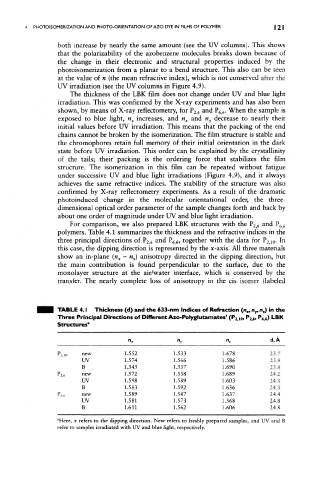
                   For comparison, we also prepared LBK structures with the P 2>6 and P 6>6
                polymers. Table 4.1 summarizes the thickness and the refractive indices in the
                three principal directions of P 2)6 and P 6>6, together with the data for P^io- In
                this case, the dipping direction is represented by the x-axis. All three materials
                show an in-plane (n x - n y) anisotropy directed in the dipping direction, but
                the main contribution is found perpendicular to the surface, due to the
                monolayer structure at the air/water interface, which is conserved by the
                transfer. The nearly complete loss of anisotropy in the cis isomer (labeled


               TABLE 4.1 Thickness (d) and the 633-nm Indices of Refraction (n x, n y, n z) in the
                                                                           p
                                                                        P
               Three Principal Directions of Different Azo-Polyglutannates' (P 2,io» 2,6» *,i) LBK
               Structures 2
                                    n x            n y           n,           d, A
                PZ,IO  new         1.552          1.533         1.678         23.7
                       UV          1.574          1.566         1.586         23.8
                       B           1.545          1.537         1.690         23.8
                       new         1.572          1.538         1.689         24.2
               P 2, 6
                       UV          1.598          1.589         1.603         24,3
                       B           1.583          1.592         1.636         24.3
               P 6j6   new         1.589          1.547         1.637         24.4
                       UV          1.581          1.573         1.568         24.8
                       B           1.611          1.562         1.606         24.8
               a
                Here, x refers to the dipping direction. New refers to freshly prepared samples, and UV and B
               refer to samples irradiated with UV and blue light, respectively.

