


Page 139 - Photoreactive Organic Thin Films
P. 139
I jg                                             ZOUHEIR SEKKAT AND WOLFGANG KNOLL

                 an a-helix that is stabilized by hydrogen bonds, with the side chains pointing
                 to the outside. These rigid-rod polyglutamates with flexible side chains
                 constitute a type of the so-called hairy rod polymers designed by Wegner. 53
                                                57
                 The synthesis is described elsewhere.
                    We used the waveguide spectroscopy technique to study the optical
                 properties of the LBK azo-polyglutamate polymers. Waveguide films could be
                 prepared by transferring up to 156 monolayers of azo-polyglutamates onto
                                                                          30
                 the silver-coated glass substrate using the vertical dipping method.  Both TE-
                 and TM-guided light modes could be coupled into these LBK structures by
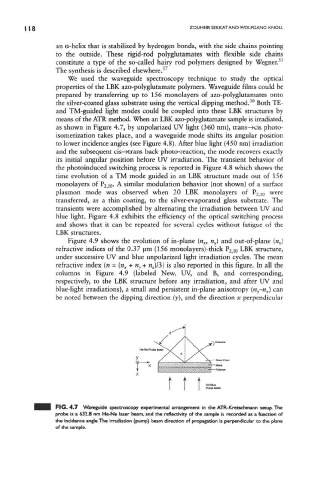
                 means of the ATR method. When an LBK azo-polyglutamate sample is irradiated,
                 as shown in Figure 4.7, by unpolarized UV light (360 nm}, trans—»cis photo-
                 isomerization takes place, and a waveguide mode shifts its angular position
                 to lower incidence angles (see Figure 4.8). After blue light (450 nm) irradiation
                 and the subsequent cis—»trans back photo-reaction, the mode recovers exactly
                 its initial angular position before UV irradiation. The transient behavior of
                 the photoinduced switching process is reported in Figure 4.8 which shows the
                 time evolution of a TM mode guided in an LBK structure made out of 156
                 monolayers of P^IQ. A similar modulation behavior (not shown) of a surface
                 plasmon mode was observed when 20 LBK monolayers of P 2;io were
                 transferred, as a thin coating, to the silver-evaporated glass substrate. The
                 transients were accomplished by alternating the irradiation between UV and
                 blue light. Figure 4.8 exhibits the efficiency of the optical switching process
                 and shows that it can be repeated for several cycles without fatigue of the
                 LBK structures.
                    Figure 4.9 shows the evolution of in-plane (n m n y) and out-of-plane (« z)
                 refractive indices of the 0.37 um (156 monolayers)-thick P 2,io LKK structure,
                 under successive UV and blue unpolarized light irradiation cycles. The mean
                 refractive index (n = (n x + n y + n z)/3) is also reported in this figure. In all the
                 columns in Figure 4.9 (labeled New, UV, and B, and corresponding,
                 respectively, to the LBK structure before any irradiation, and after UV and
                 blue-light irradiations), a small and persistent in-plane anisotropy (n y-n x) can
                 be noted between the dipping direction (y), and the direction x perpendicular


                 FIG. 4.7 Waveguide spectroscopy experimental arrangement in the ATR-Kretschmann setup. The
                 probe is a 632.8 nm He-Ne laser beam, and the reflectivity of the sample is recorded as a function of
                 the incidence angle. The irradiation (pump) beam direction of propagation is perpendicular to the plane
                 of the sample.

