


Page 276 - Physical chemistry understanding our chemical world
P. 276
PROPERTIES OF LOWRY–BRØNSTED ACIDS AND BASES      243

             stage in the battle, the German forces filled the air above the enemy trenches with
             chlorine gas.
               Elemental chlorine Cl 2 dissolves slightly in water, and hydrolyses
             some of the water to yield hypochlorous acid, HOCl, according to  Hypochlorous acid,
                                                                          HOCl, is one of the
                                                                          active components in
                                                                  (6.15)
                        Cl 2(aq) + H 2 O (l) −−→ HCl (aq) + HOCl (aq)
                                                                          household bleach.
               The reaction in Equation (6.15) occurs readily in the lungs and
             eyes (the sensitive tissues of which are lined with water) to cause
                                                                          After this battle, both
             irreparable damage. Troops exposed to chlorine apparently experi-
                                                                          sides showed reluc-
             enced a particularly slow and nasty death.
                                                                          tance to employ poi-
               The German troops did not advance, because they were not sure
                                                                          sonous gases again,
             if the gas masks issued to their own troops could withstand the  beingafraidit would
             chlorine. They were also deterred by the incursion of a Canadian  drift back and poi-
             regiment. But one of the young Canadian soldiers knew a little  son their own troops.
             chemistry: sniffing the gas, he guessed its identity correctly, and  Cl 2 gas also caused
             ordered the soldiers to cover their faces with handkerchiefs (or  extensive corrosion
             bandages) soaked in their own urine. The idea spread quickly, and  of rifles and artillery
             the Canadians, together with two Yorkshire territorial battalions,  breech blocks, making
                                                                          them unusable.
             were able to push back the German troops.
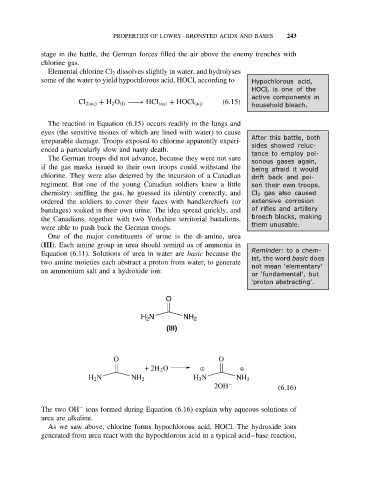
               One of the major constituents of urine is the di-amine, urea
             (III). Each amine group in urea should remind us of ammonia in
                                                                          Reminder:toa chem-
             Equation (6.11). Solutions of urea in water are basic because the
                                                                          ist, the word basic does
             two amine moieties each abstract a proton from water, to generate
                                                                          not mean ‘elementary’
             an ammonium salt and a hydroxide ion:
                                                                          or ‘fundamental’, but
                                                                          ‘proton abstracting’.
                                                 O

                                          H 2 N       NH 2
                                                 (III)


                                  O                              O
                                           + 2H 2 O
                           H 2 N       NH 2              H 3 N        NH 3
                                                               2OH  −             (6.16)


                        −
             The two OH ions formed during Equation (6.16) explain why aqueous solutions of
             urea are alkaline.
               As we saw above, chlorine forms hypochlorous acid, HOCl. The hydroxide ions
             generated from urea react with the hypochlorous acid in a typical acid–base reaction,

